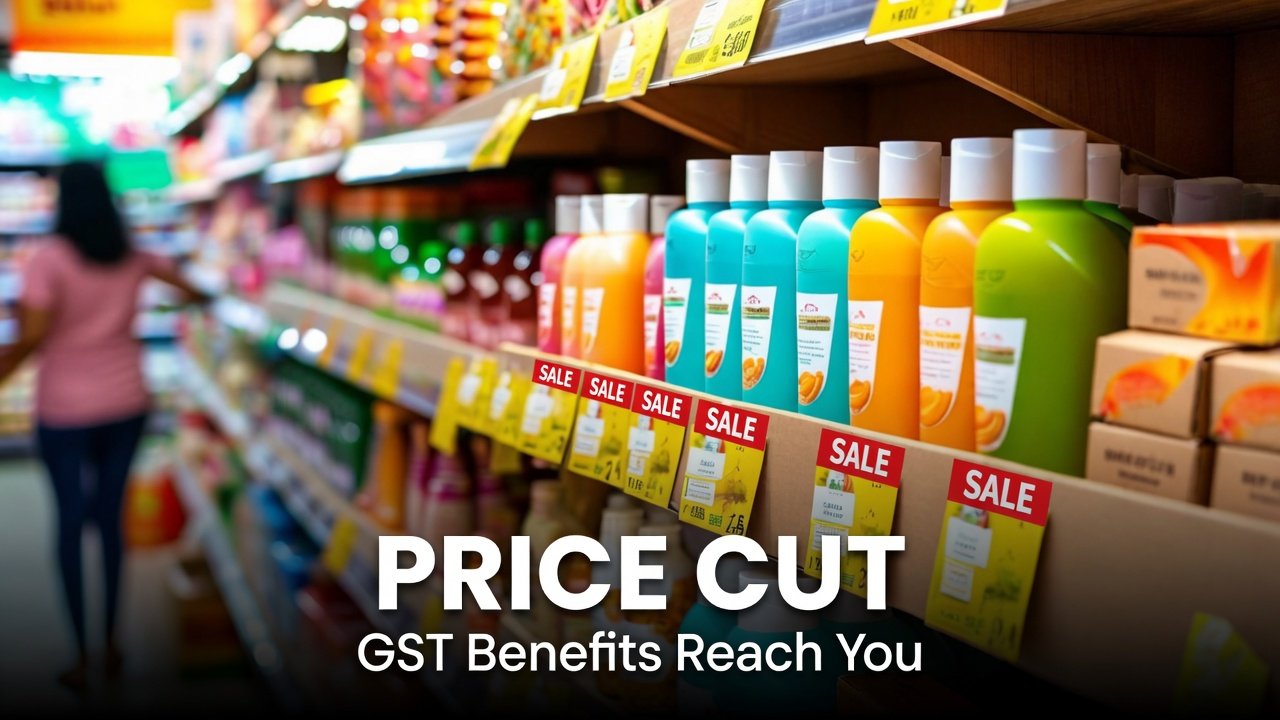
FMCG Companies Cut Prices on Soaps, Diapers and Toothpaste as GST Benefits Reach Consumers
Leading FMCG companies in India have announced price cuts across a range of everyday consumer products, including soaps, shampoos, baby diapers, toothpaste, razors and after-shave products. The revised prices are effective from September 22, following the government’s reduction in GST rates on several household and personal-care products.
Companies including Hindustan Unilever (HUL), Procter & Gamble (P&G), Emami, ITC, Dabur and other consumer-goods makers have issued revised price lists and communicated the changes to distributors and retailers.
The move has also put FMCG stocks in focus, as investors assess how lower consumer prices could affect demand, sales volumes and company margins.
GST Rate Cuts Trigger FMCG Price Reductions
The price reductions follow the GST Council’s September 2025 rate rationalisation, under which GST on several commonly used personal-care products was reduced.
Products such as hair oil, shampoo, toothpaste, toilet soap and shaving products moved from higher GST rates to the 5% slab. The government said the changes were intended to simplify the GST structure while passing the benefit of lower taxation to consumers.
The revised GST rates on goods came into effect on September 22, 2025. The government also introduced measures allowing companies to update the MRP of existing unsold packaged inventory through revised stickers, subject to specified conditions.
HUL, P&G and Emami Revise Prices
Several major FMCG companies have already announced new prices for their product portfolios.
Procter & Gamble revised MRPs across brands including Vicks, Head & Shoulders, Pantene, Pampers, Gillette, Old Spice and Oral-B. For example, Vicks Action 500 Advance and Vicks Inhaler were reported to see their prices reduced from ₹69 to ₹64 following the GST change.
HUL and Emami have also communicated revised prices to distributors as companies work to pass the tax benefit through their distribution networks.
The changes cover products used regularly by households, meaning the impact of the GST reduction could extend across several categories of the FMCG market.
Soaps, Toothpaste and Baby Products Become Cheaper
Personal-care products are among the major categories affected by the GST restructuring.
Toilet soaps, toothpaste, shampoos and shaving products were moved to the 5% GST slab from higher rates. Baby-care products such as diapers have also seen price reductions following the tax changes.
P&G’s Pampers portfolio, for instance, was among the baby-care products covered by revised pricing after GST rates on the category were reduced.
For consumers, the reductions are expected to be reflected through lower MRPs on newly produced stock as well as adjustments to existing inventory through permitted trade mechanisms.
Food and Beverage FMCG Products Also See Price Cuts
The GST benefit is not limited to personal-care products.
FMCG companies have also reduced prices across a wide range of food and beverage categories, including namkeen, bhujia, coffee, tea, butter, ghee, chocolates, ice cream and other packaged products.
The government’s GST rationalisation moved many processed food products from the 12% or 18% slabs to 5%, while some staple products were moved to the nil-rate category.
This has expanded the potential impact of the tax changes beyond household and personal-care products.
Why FMCG Stocks Are in Focus
The latest FMCG price cuts are also being watched by investors because lower prices can influence both consumption and company financial performance.
If companies successfully pass the GST benefit to consumers, lower retail prices could support demand and potentially encourage higher volumes, particularly for frequently purchased household products.
At the same time, companies have to manage the transition from old-priced inventory to products carrying revised MRPs. Industry reports indicate that companies have used trade discounts and other mechanisms to align existing stocks with the new GST structure.
The effect on individual companies will depend on product mix, pricing strategy, distribution costs and the extent to which the tax benefit translates into higher volumes.
Festive Season Could Support Consumer Demand
The timing of the price reductions is also important for FMCG companies because the period around the festive season is traditionally associated with increased consumer spending.
Lower prices on everyday products could provide consumers with additional purchasing power, while FMCG companies could benefit if demand and volumes increase.
Industry observers are therefore watching whether the GST changes lead primarily to lower prices, higher consumption or a combination of both.
Companies Have to Pass on the GST Benefit
The government’s approach has placed emphasis on ensuring that consumers receive the benefit of lower GST rates.
The Department of Consumer Affairs issued guidance allowing manufacturers, packers and importers to use revised price stickers on unsold pre-packaged products under specified conditions, helping companies transition to the new tax structure without unnecessarily disrupting existing inventory.
This transition is particularly relevant for FMCG companies because products move through multiple layers of distribution before reaching consumers.
What the FMCG Price Cuts Mean for Consumers
For consumers, the immediate impact is likely to be visible in the form of lower MRPs across several everyday categories.
Soaps, toothpaste, shampoos, diapers and other personal-care products are purchased regularly, meaning even relatively small reductions in individual product prices can add up over time for households that purchase these products frequently.
However, the exact reduction varies by product and brand. Consumers may also see old and revised-price packages in stores during the transition period as inventory moves through the supply chain.
Looking Ahead
The latest FMCG price cuts mark a significant pass-through of GST benefits across India’s consumer-goods market. Major companies have revised prices for products ranging from soaps and toothpaste to diapers, shampoos, food products and beverages.
For investors, the focus now shifts toward how the lower prices affect consumer demand, sales volumes, revenue growth and margins across FMCG companies. For consumers, the changes could provide some relief on frequently purchased household and personal-care products.
The coming months will show how strongly the GST changes translate into higher consumption and whether the benefits are sustained across different FMCG categories.
Frequently Asked Questions
1. Why are FMCG companies cutting prices?
FMCG companies are reducing prices to pass on the benefit of lower GST rates to consumers.
2. When did the FMCG price cuts become effective?
The revised prices were made effective from September 22, 2025, following the implementation of the GST rate changes.
3. Which FMCG products have become cheaper?
Products affected include soaps, shampoos, toothpaste, baby diapers, razors, after-shave products and several packaged food and beverage items.
4. Which companies have announced FMCG price cuts?
Companies including HUL, P&G, Emami, ITC, Dabur, Nestle, RCPL and Amul have announced revised prices across various product categories.
5. What happened to GST on toothpaste?
Toothpaste was among the personal-care products whose GST rate was reduced from 18% to 5% under the GST rate rationalisation.
6. Are baby diapers also included in the price cuts?
Yes. Baby diapers and other baby-care products have been included in the revised pricing announced by FMCG companies following the GST changes.
7. Did soap prices also fall?
Yes. Toilet soaps were among the products moved to the 5% GST slab, and FMCG companies subsequently announced revised prices.
8. Why are FMCG stocks in focus?
Investors are assessing whether lower product prices can stimulate consumer demand and increase sales volumes, while also considering the potential impact on company margins.
9. Will all FMCG products become cheaper?
No. The impact depends on the GST classification and individual company’s pricing decisions. The exact reduction also varies by product and brand.
10. How will consumers receive the GST benefit?
Consumers can receive the benefit through lower MRPs on revised products. Companies have also used permitted mechanisms such as revised stickers, trade discounts and other distribution adjustments to transition existing inventory.