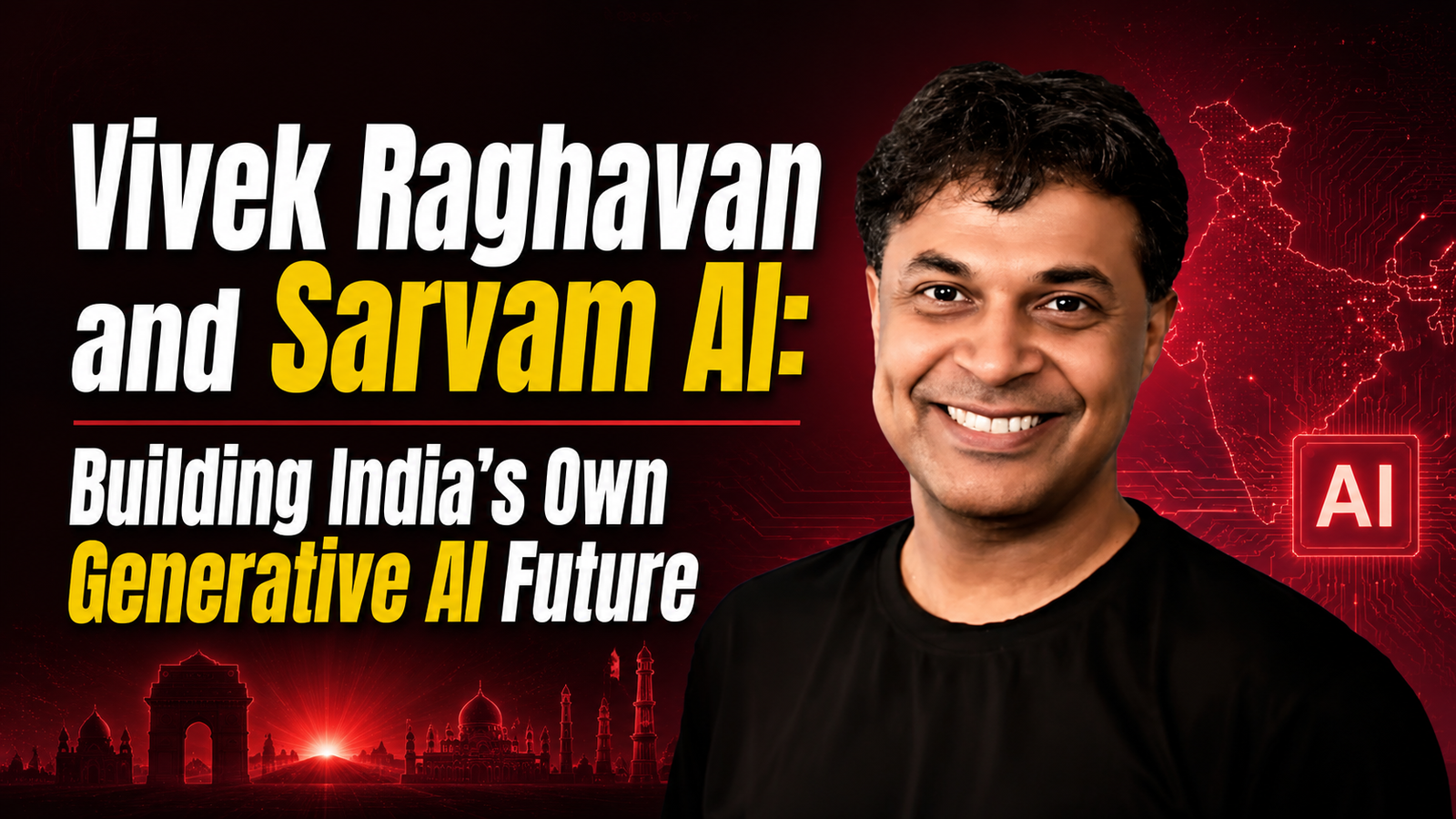
Vivek Raghavan Sarvam AI: Building India’s Own Generative AI Future
Vivek Raghavan Sarvam AI represents one of the most interesting stories emerging from India’s rapidly growing artificial intelligence ecosystem. Raghavan is working at the forefront of India’s deep-tech movement, with Sarvam AI focused on developing foundational generative AI models designed specifically for India’s diverse linguistic and cultural landscape.
While much of the global AI race has been dominated by companies building models primarily around English and a handful of major languages, India’s situation is very different.
The country has hundreds of languages and dialects, along with enormous cultural and regional diversity. Building AI that genuinely works for this environment requires a different approach.
Who Is Vivek Raghavan?
Vivek Raghavan is an entrepreneur and technology leader associated with Sarvam AI, an Indian artificial intelligence company focused on developing advanced AI models for the Indian market.
His work is part of a broader effort to establish India as a serious player in the global AI ecosystem.
Rather than simply bringing existing international AI technologies to Indian users, the vision behind Sarvam AI focuses on building foundational technology that can understand and work effectively with Indian languages and use cases.
This makes Raghavan’s work particularly relevant to India’s growing deep-tech sector.
What Is Sarvam AI Building?
Sarvam AI is focused on developing generative AI models designed with India’s unique requirements in mind.
Generative AI refers to artificial intelligence systems capable of generating text, speech, images, code and other forms of content based on user instructions.
For India, one of the biggest challenges is language.
A large section of the country’s population communicates primarily in regional languages rather than English. AI systems that perform well in English may not necessarily provide the same quality of experience in Indian languages.
Sarvam AI is working to address this gap.
Why Indian Languages Matter for AI
India’s linguistic diversity creates both a challenge and an enormous opportunity for artificial intelligence.
People across the country use languages such as Hindi, Tamil, Telugu, Bengali, Marathi, Kannada, Malayalam and many others in their daily lives.
If AI technology is available primarily in English, a large section of the population may not be able to use its full potential.
This is why the development of AI models that can understand India’s languages is so important.
The Vivek Raghavan Sarvam AI story is therefore not just about another AI startup. It is also about building technology that can make artificial intelligence more accessible to a much larger part of India’s population.
AI Built for India’s Cultural Landscape
Language is only one part of the challenge.
India’s cultural environment is equally diverse, with different regions having their own traditions, expressions, social contexts and ways of communicating.
AI systems need to understand context to produce useful responses.
A model trained primarily on data from Western markets may not always understand Indian references, cultural nuances or regional expressions accurately.
Building models with India’s linguistic and cultural landscape in mind could help make AI systems more relevant to Indian users.
Why Sarvam AI Is Part of India’s Deep-Tech Movement
India’s startup ecosystem has historically produced major companies in areas such as e-commerce, fintech, SaaS and consumer technology.
Deep tech represents a different category.
Deep-tech companies often require significant investment in research, specialised talent, computing infrastructure and long development cycles.
Artificial intelligence is one of the most important areas within this movement.
Companies such as Sarvam AI are attempting to build foundational technology rather than simply creating another consumer application.
That makes the company’s work strategically important for India’s technology ecosystem.
The Bigger Opportunity for India
The potential applications of Indian-language AI are enormous.
Generative AI could eventually help people access government services, education, healthcare information, financial services and business tools in languages they are most comfortable using.
Small businesses could also use AI-powered tools without needing advanced English-language skills.
This could help bring digital technology to users who have historically been underserved by technology products designed primarily for English-speaking audiences.
AI Could Change How Indians Interact With Technology
For many users, the biggest benefit of AI may not come from another chatbot or productivity application.
It could come from being able to interact with technology naturally in their own language.
Imagine a small business owner asking an AI assistant for help with inventory, a farmer seeking information in a regional language or a student using an AI tutor without needing to switch to English.
These are the kinds of possibilities that make Indian-language AI particularly significant.
Challenges in Building Indian AI Models
Building foundational AI models for India is not easy.
Training large AI systems requires enormous amounts of high-quality data and computing resources.
Indian languages can also present unique technical challenges because some have relatively limited digital datasets compared with English.
There are also differences in scripts, grammar, pronunciation and regional usage.
Developers need to ensure that models are not only capable of generating language but can also understand context and produce reliable responses.
Why Vivek Raghavan’s Work Matters
The significance of Vivek Raghavan Sarvam AI lies in the company’s focus on building AI infrastructure around India’s specific needs.
India is not simply another market for artificial intelligence.
Its enormous population, linguistic diversity and rapidly expanding digital economy make it one of the world’s most important potential AI markets.
Building technology locally could allow Indian companies and institutions to have greater control over the AI systems they use while also creating intellectual property and technical expertise within the country.
India’s AI Ambitions Are Growing
India is increasingly looking to strengthen its position in the global artificial intelligence race.
The country has a large pool of technology talent and a growing startup ecosystem, creating favourable conditions for AI innovation.
However, competing globally will require more than adopting technologies developed elsewhere.
India will also need companies capable of building foundational models, infrastructure and AI products.
Sarvam AI’s work fits into this larger ambition.
What Comes Next for Sarvam AI?
The long-term success of Sarvam AI will depend on how effectively its models can perform in real-world applications.
The company will need to continue improving model quality, expanding language capabilities and making its technology useful for businesses, developers and everyday users.
If successful, its work could help establish a stronger foundation for India’s AI ecosystem.
For Vivek Raghavan, the opportunity is much bigger than building another technology company. It is about helping create AI systems that understand the way India communicates, works and interacts with technology.
Frequently Asked Questions (FAQs)
1. Who is Vivek Raghavan?
Vivek Raghavan is a technology entrepreneur associated with Sarvam AI and India’s emerging artificial intelligence and deep-tech ecosystem.
2. What is Sarvam AI?
Sarvam AI is an Indian AI company focused on developing generative AI and foundational AI models tailored to India’s linguistic and cultural environment.
3. Why is Sarvam AI focusing on Indian languages?
India has enormous linguistic diversity, and many people primarily communicate in regional languages. AI models designed for these languages could make advanced technology accessible to a much larger population.
4. What does generative AI mean?
Generative AI refers to artificial intelligence systems capable of creating content such as text, speech, images or code based on instructions from users.
5. Why is Indian-language AI important?
Indian-language AI could help people interact with digital services and AI tools in languages they understand most naturally, potentially expanding access to technology across the country.
6. What challenges does Sarvam AI face?
Key challenges include access to high-quality multilingual data, computing requirements, model accuracy, language diversity and ensuring that AI systems understand India’s cultural context.
7. Is Sarvam AI part of India’s deep-tech ecosystem?
Yes. Sarvam AI’s focus on foundational artificial intelligence models places it within India’s growing deep-tech ecosystem.
8. Why is Vivek Raghavan’s work significant?
The Vivek Raghavan Sarvam AI story highlights India’s effort to build homegrown AI capabilities rather than relying entirely on technology developed in other markets.