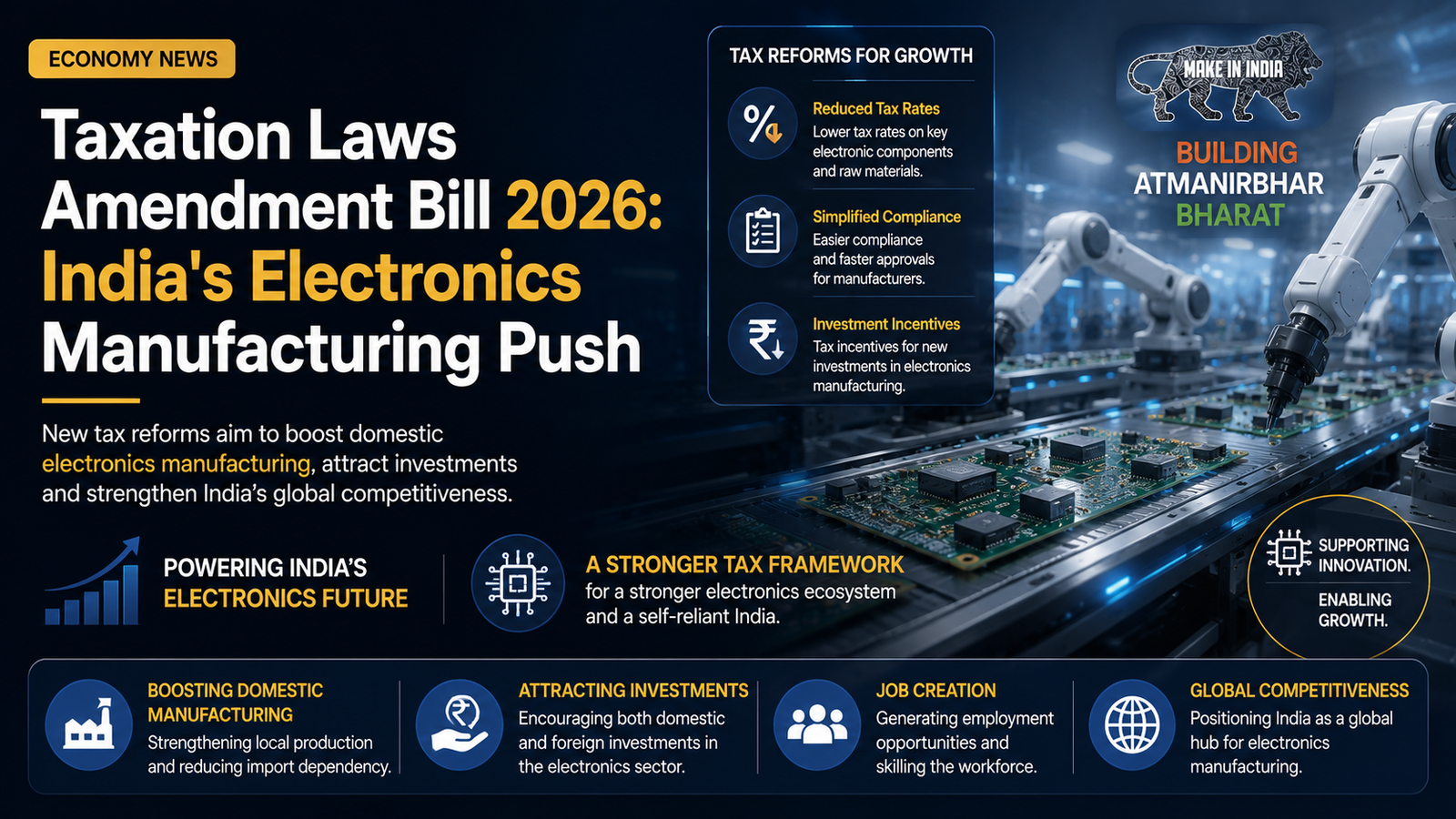
India is taking another major step toward becoming a global manufacturing powerhouse. The Taxation Laws (Amendment) Bill, 2026 proposes extending tax exemptions for contract manufacturing of electronic products until FY2040-41, while also relaxing investment rules for Foreign Portfolio Investors (FPIs).
The move is more than a tax reform. It provides long-term policy certainty for global manufacturers and investors, positioning India as a stronger alternative to China in global supply chains. At the same time, easier FPI norms are expected to attract additional foreign capital into Indian financial markets.
What Is the Taxation Laws Amendment Bill 2026?
The proposed legislation introduces two major reforms.
First, it extends tax exemptions for companies involved in contract manufacturing of electronics, including products such as:
- Mobile phones
- Laptops
- Tablets
- Consumer electronics
- Electronic components
The tax benefits are proposed to continue until FY2040-41, giving manufacturers nearly two decades of policy stability.
Second, the Bill proposes to simplify rules for Foreign Portfolio Investors (FPIs) by easing entry requirements and reducing minimum corpus conditions, making India a more attractive destination for global investment funds.
Why Is the Extension Until FY2040-41 Significant?
Manufacturing investments require long planning cycles.
Global companies investing billions of dollars in factories, equipment, and supplier networks need confidence that government policies will remain stable.
By extending tax benefits for almost twenty years, India provides businesses with:
- Long-term investment certainty
- Better financial planning
- Lower tax-related risks
- Greater confidence to expand manufacturing capacity
For multinational companies, predictable policy is often as valuable as tax incentives themselves.
How Does This Strengthen India’s Position Against China?
For years, China has dominated global electronics manufacturing.
However, rising labour costs, geopolitical tensions, supply chain disruptions, and efforts by multinational companies to diversify production have encouraged manufacturers to explore alternative destinations.
India is emerging as one of the strongest candidates because of:
- A large skilled workforce
- Expanding manufacturing infrastructure
- Production Linked Incentive (PLI) schemes
- Growing domestic consumer market
- Long-term tax policy support
The latest tax proposal further strengthens India’s competitiveness in attracting global electronics manufacturers.
Why Companies Like Apple and Samsung Could Benefit
Global technology companies increasingly prefer to diversify manufacturing across multiple countries instead of relying heavily on one location.
The proposed tax framework supports companies by offering:
- Stable tax policies
- Lower manufacturing uncertainty
- Improved long-term investment planning
- Better supply chain resilience
For companies such as Apple, Samsung, and their contract manufacturing partners, long-term policy certainty can influence future expansion decisions and encourage additional investment in India.
How Will Contract Manufacturers Benefit?
Contract manufacturers play a critical role in assembling products for global technology brands.
Extended tax exemptions could help them:
- Expand production capacity
- Invest in advanced manufacturing technologies
- Increase exports
- Create employment opportunities
- Strengthen local supplier ecosystems
This also supports India’s ambition of becoming a global electronics export hub.
What Are the FPI Reforms?
The Bill also proposes important changes for Foreign Portfolio Investors (FPIs).
Key proposals include:
- Relaxed entry requirements
- Lower minimum corpus thresholds
- Easier access to Indian financial markets
These changes are designed to make it simpler for international investment funds to participate in Indian equity and debt markets.
Why Are Easier FPI Rules Important?
Foreign Portfolio Investors provide significant liquidity to financial markets.
Higher foreign participation can contribute to:
- Increased capital inflows
- Better market liquidity
- Improved investor confidence
- Lower cost of capital for companies
- Greater depth in Indian capital markets
Simplified regulations may encourage more global funds to allocate capital to India.
Economic Benefits of the Proposed Reforms
If implemented successfully, the reforms could generate multiple long-term benefits.
Higher Manufacturing Investment
Stable tax policies may encourage multinational companies to establish new production facilities in India.
Job Creation
Expansion of electronics manufacturing can create employment across factories, logistics, engineering, and supplier industries.
Export Growth
Higher domestic production may increase exports of electronics and reduce reliance on imports.
Greater Foreign Investment
Relaxed FPI rules could increase foreign capital inflows into Indian stock and bond markets.
Stronger Supply Chains
Diversifying global manufacturing into India can improve resilience against international disruptions.
Challenges That Still Need Attention
Although tax certainty is a major advantage, several challenges remain.
Infrastructure Development
Manufacturing growth requires reliable logistics, ports, roads, and power supply.
Skilled Workforce
Continued investment in technical education and workforce training will be necessary.
Ease of Doing Business
Faster approvals and simplified compliance remain important for attracting global manufacturers.
Global Competition
Countries such as Vietnam, Indonesia, and Mexico are also competing aggressively for electronics manufacturing investments.
What Does This Mean for India’s Economy?
The proposed reforms support two important objectives simultaneously.
On one hand, long-term tax incentives encourage manufacturing, exports, and industrial growth.
On the other, relaxed FPI regulations improve access to global capital and strengthen India’s financial markets.
Together, these initiatives reinforce India’s ambition to become both a global manufacturing hub and a preferred investment destination.
Final Thoughts
The Taxation Laws Amendment Bill 2026 represents a significant policy shift aimed at strengthening India’s position in global manufacturing and international finance. By extending tax exemptions for electronics contract manufacturing until FY2040-41, the government is providing businesses with the long-term certainty needed for large-scale investments.
At the same time, proposed relaxations for Foreign Portfolio Investors have the potential to attract greater foreign capital into Indian markets. While infrastructure, execution, and global competition will continue to influence outcomes, the proposed reforms could play a crucial role in positioning India as a leading alternative manufacturing destination and an increasingly attractive investment hub.
FAQ
What is the Taxation Laws Amendment Bill 2026?
It is a proposed law that extends tax benefits for electronics contract manufacturing until FY2040-41 and relaxes investment norms for Foreign Portfolio Investors.
Why is the tax exemption extension important?
Long-term tax certainty encourages global manufacturers to make large investments in production facilities and supply chains in India.
Which industries are expected to benefit?
Electronics manufacturers producing mobile phones, laptops, consumer electronics, and related components are expected to benefit the most.
How do the proposed FPI reforms help India?
Relaxed entry requirements can attract more foreign investment, improve market liquidity, and strengthen India’s capital markets.
Will these reforms help India compete with China?
The reforms strengthen India’s attractiveness as a global manufacturing destination by providing policy stability, encouraging investment, and supporting supply chain diversification.