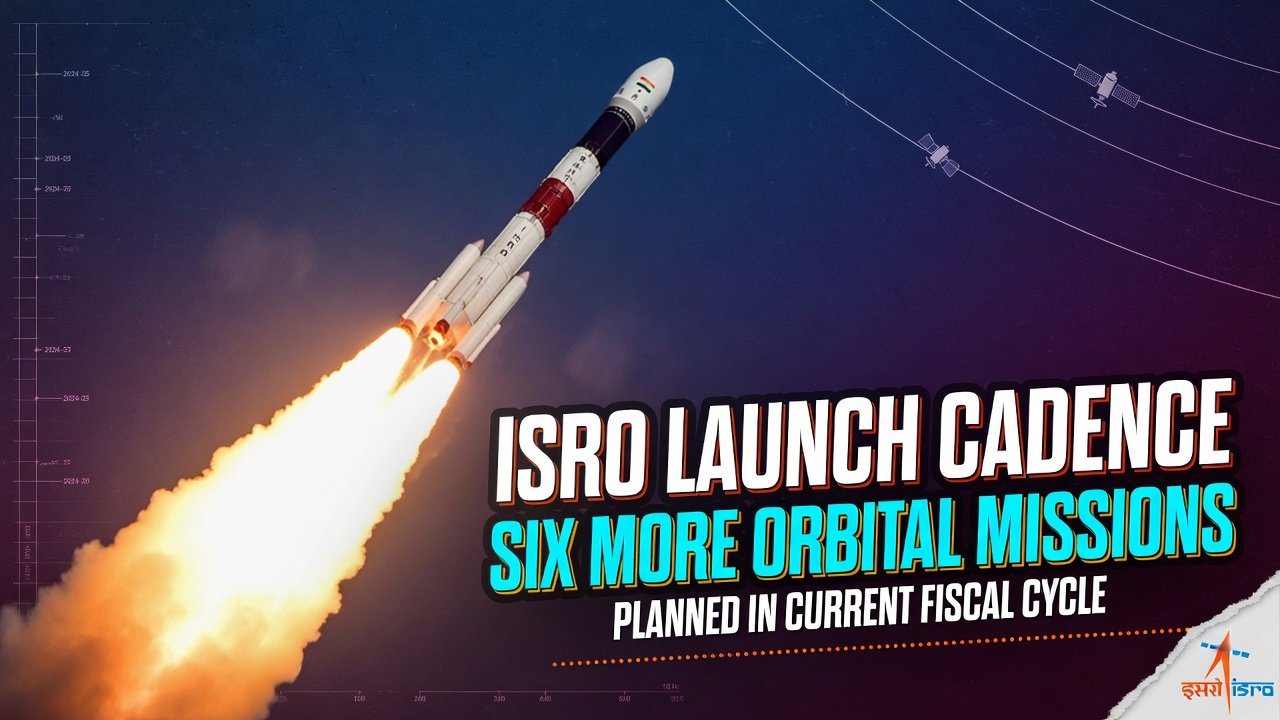
ISRO Launch Cadence Set to Increase With Six More Orbital Missions
The ISRO Launch Cadence is expected to pick up significantly, with the Indian Space Research Organisation planning six additional orbital launches during the current fiscal cycle.
The announcement comes after the recent GSLV-F17 deployment and highlights India’s growing focus on maintaining a steady pipeline of space missions. Among the most important missions in the upcoming schedule are the uncrewed test flights associated with the Gaganyaan human spaceflight programme.
Six Additional Launches Planned
ISRO’s leadership has outlined plans for six more orbital missions within the current financial cycle.
A higher launch frequency would represent an important step for India’s space programme, particularly as the organisation manages multiple scientific, commercial and human-spaceflight objectives at the same time.
The planned missions are expected to involve different launch vehicles and payload requirements, reflecting the increasingly diverse nature of India’s space activities.
GSLV-F17 Deployment Marks Recent Milestone
The latest planning comes after the successful deployment associated with the GSLV-F17 mission.
The Geosynchronous Satellite Launch Vehicle remains an important part of India’s launch capability, particularly for missions requiring the placement of heavier payloads into higher-energy orbits.
Each successful mission also contributes operational experience that can support future launches.
For ISRO, maintaining a reliable launch schedule is becoming increasingly important as the country’s space ambitions expand.
Gaganyaan Remains a Major Priority
A key priority within the upcoming launch programme is the Gaganyaan mission.
India’s human spaceflight programme is designed to demonstrate the country’s capability to send astronauts into low-Earth orbit and safely return them to Earth.
Before astronauts fly, ISRO must conduct extensive testing of the spacecraft, launch vehicle, crew escape systems, life-support systems and recovery procedures.
That makes uncrewed test missions a critical part of the programme.
Why Uncrewed Flights Matter
Uncrewed Gaganyaan flights allow ISRO to test the spacecraft and associated systems without putting astronauts at risk.
These missions can provide valuable information about launch performance, spacecraft behaviour, re-entry conditions and recovery operations.
The results can then be used to identify technical issues and improve systems before crewed missions are attempted.
For a human-spaceflight programme, this gradual testing approach is essential because even small technical failures can have serious consequences when astronauts are involved.
Increasing India’s Space Launch Capability
The planned launch cadence also reflects the broader expansion of India’s space sector.
ISRO is working on missions involving Earth observation, communications, navigation, scientific research and exploration alongside its human-spaceflight programme.
A more regular launch schedule can help the organisation manage this growing portfolio more efficiently.
It can also provide greater opportunities for Indian industry and private-sector companies participating in the space ecosystem.
Importance for India’s Space Economy
India has been attempting to increase its presence in the global space economy.
More frequent launches can support satellite deployment requirements while also creating opportunities for commercial launch services.
Private Indian space companies are increasingly developing launch vehicles, spacecraft, satellite technologies and other components.
ISRO’s continued launch activity can complement this emerging ecosystem by providing infrastructure, technical expertise and a national-level space programme around which the wider industry can develop.
Human Spaceflight Adds New Complexity
The Gaganyaan programme presents a different level of technical complexity compared with conventional satellite launches.
A human-rated launch system must meet significantly stricter safety and reliability requirements.
The spacecraft must also be capable of supporting astronauts during the mission and protecting them during the high-speed journey back through Earth’s atmosphere.
Consequently, ISRO’s upcoming uncrewed missions are more than routine launches. They are important validation exercises for India’s future human-spaceflight capability.
A Busy Period for ISRO
Six additional orbital missions in a single fiscal cycle would keep ISRO’s launch infrastructure and technical teams highly active.
The organisation must coordinate launch vehicle preparation, spacecraft integration, range operations, tracking systems and post-launch activities across multiple missions.
Maintaining a predictable cadence can also help reduce delays and improve the overall utilization of India’s launch facilities.
Gaganyaan Could Shape Future Missions
The experience gained through Gaganyaan testing could have implications beyond the first Indian human spaceflight mission.
Human-spaceflight technologies can contribute to future space-station activities, advanced spacecraft development and longer-term exploration programmes.
India has also expressed ambitions involving a national space station and more sophisticated human-spaceflight capabilities in the coming years.
Successful testing therefore has significance for the country’s broader long-term space strategy.
What the New Launch Schedule Signals
The decision to plan multiple additional launches indicates that ISRO is moving toward a more sustained operational rhythm.
Rather than treating major missions as isolated events, the organisation is building a pipeline that includes multiple launch vehicles, satellite missions and human-spaceflight preparations.
This approach could strengthen India’s ability to execute complex space programmes while simultaneously supporting commercial and scientific objectives.
What to Watch Next
The upcoming uncrewed Gaganyaan missions will attract particular attention because of their role in validating India’s human-spaceflight systems.
The performance of these flights, along with the other planned orbital missions, will provide an indication of how effectively ISRO can maintain its targeted launch cadence.
The coming months are therefore likely to be an important period for India’s space programme.
Key Takeaway
The ISRO Launch Cadence is expected to accelerate, with six additional orbital missions planned during the current fiscal cycle.
The upcoming programme places particular emphasis on uncrewed Gaganyaan test flights, which are crucial for validating India’s human-spaceflight systems before astronauts are eventually sent into orbit.
The expanded launch schedule also reflects India’s broader ambitions in satellite deployment, commercial space activity, scientific missions and future human exploration.
FAQs
1. What is ISRO’s latest launch plan?
ISRO leadership has confirmed plans for six additional orbital launches during the current fiscal cycle.
2. What is GSLV-F17?
GSLV-F17 refers to a mission involving India’s Geosynchronous Satellite Launch Vehicle, one of ISRO’s key launch systems.
3. What is the Gaganyaan mission?
Gaganyaan is India’s human-spaceflight programme, designed to demonstrate the country’s ability to send astronauts into low-Earth orbit and safely return them.
4. Why are uncrewed Gaganyaan flights important?
They allow ISRO to test critical spacecraft, launch and recovery systems before astronauts are placed on board.
5. How many additional orbital launches are planned?
Six additional orbital launches are planned within the current fiscal cycle.
6. Will all six launches be related to Gaganyaan?
No. Gaganyaan test flights are a priority, but the broader launch programme can include other satellite and space missions as well.
7. Why is launch cadence important for ISRO?
A consistent launch schedule helps ISRO manage multiple missions, improve operational efficiency and support India’s expanding space ecosystem.
8. How can Gaganyaan benefit India’s space programme?
The programme can strengthen India’s human-spaceflight expertise and provide technological experience for future space stations and advanced exploration missions.
9. Does ISRO’s launch activity support private space companies?
Yes. A growing national space programme can create opportunities for Indian private companies involved in launch vehicles, satellites, components and related technologies.
10. What should be watched next?
The performance of upcoming uncrewed Gaganyaan tests and the execution of the additional planned orbital missions will be key developments to watch.