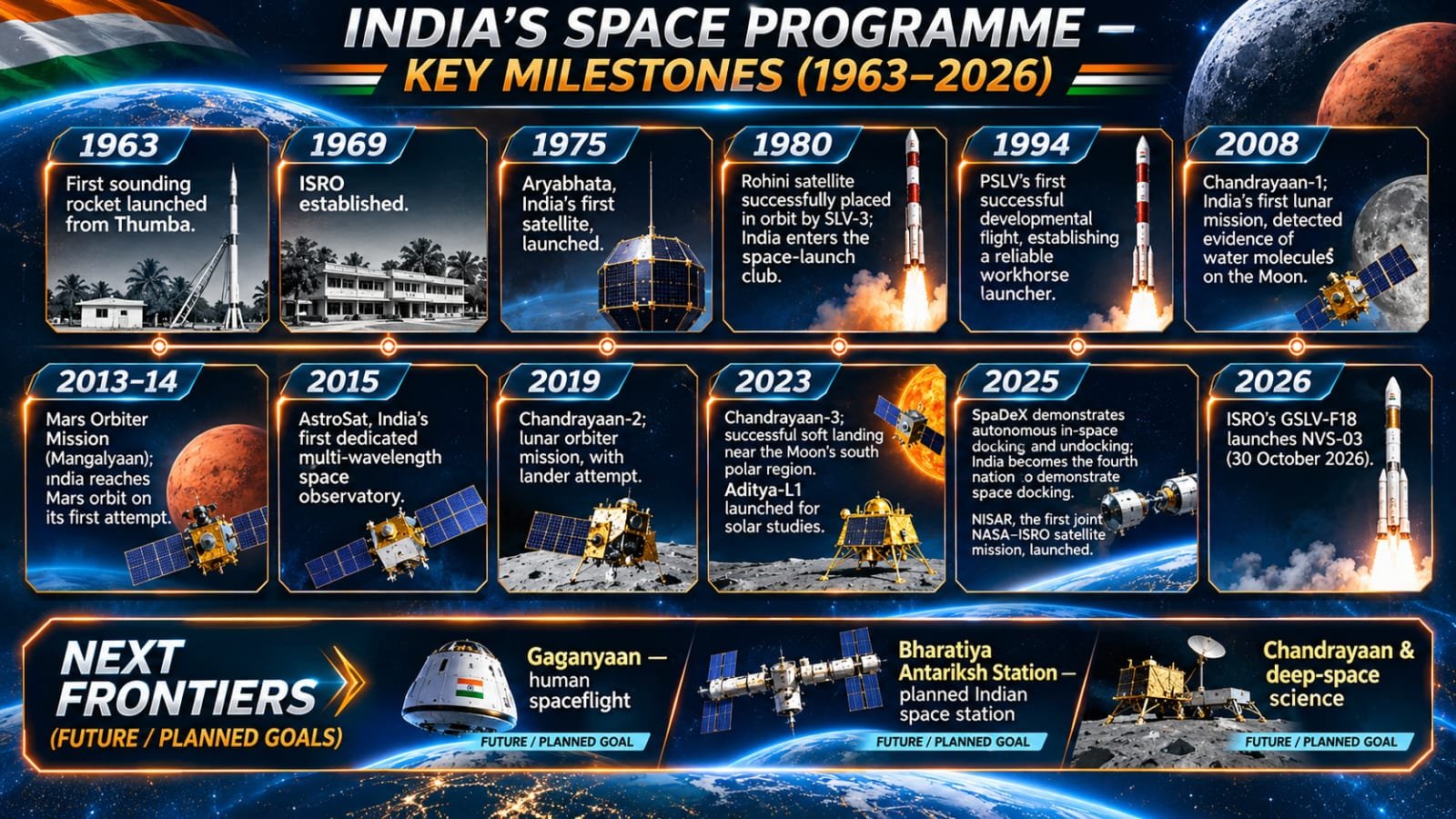
From military intelligence and special operations to artificial intelligence, quantum science and advanced space systems, an emerging indigenous technology initiative highlights India’s growing emphasis on affordable, home-grown solutions for future strategic requirements.
The global space race is moving beyond satellite launches and conventional space exploration. The next phase of competition will increasingly revolve around orbital manoeuvring, space station operations, advanced propulsion systems and the ability to sustain complex infrastructure in orbit. The United States, China and Russia are committing substantial resources to these technologies, recognising their long-term scientific, economic and strategic importance.
Against this backdrop, an emerging Indian technological development involving a specialised research team associated with Wing Commander (Dr.) Pushkal Vijay Dwivedi and DRDO has drawn attention. The project involves a specialised component intended to contribute to the directional and orbital control capabilities of future space stations.
The development reflects a wider shift in India’s technological ecosystem, where military experience, independent research initiatives and advanced scientific disciplines are increasingly converging to address complex engineering challenges.
A New Approach to Space Station Control
Maintaining a space station’s orientation and orbital position requires sophisticated systems capable of making precise adjustments in the space environment. These operations are essential for station stability, navigation, docking and the management of long-duration space missions.
The component developed by the team associated with Dwivedi is based on an interdisciplinary scientific approach incorporating chemistry, astrophysics, quantum physics, quantum technology and unconventional energy concepts.
The proposed technology is particularly notable for its emphasis on achieving advanced technical capabilities at a comparatively low development cost. While established space powers have invested heavily in propulsion and orbital-control research, the Indian initiative seeks to develop a more economical indigenous solution.
The invention has been submitted for patent protection, with Wing Commander Pushkal Vijay Dwivedi and his team identified as inventors. His invention is a one of its kind in entire globe.
Considering its strategic and technical sensitivity, the component’s name, detailed configuration, material composition and operating methodology remain classified. Its prospective application in India’s future space station programme gives the development particular relevance to the country’s long-term space objectives.
DRDO and the Growing Role of Indigenous Technology
The reported collaboration involving DRDO and the research team highlights the importance of developing specialised technologies within India rather than relying exclusively on imported systems.
Space engineering increasingly draws upon multiple scientific disciplines. Quantum research, advanced materials, chemical engineering, computational modelling and unconventional energy concepts are opening new possibilities for developing next-generation systems.
For India, such research is particularly important as the country moves towards more ambitious human spaceflight and orbital infrastructure programmes.
The development also brings attention to the contribution that specialised private research teams and experienced defence professionals can make to the country’s indigenous technology ecosystem.
A Military Career Spanning Intelligence, Air Defence and Special Operations
Wing Commander (Dr.) Pushkal Vijay Dwivedi’s background provides an operational dimension to this technological story.
During his service in the Indian Air Force, his professional areas included counter-intelligence, intelligence operations, air defence and special operations. These assignments involve complex operational environments where information security, threat assessment, strategic planning and rapid decision-making are essential.
He is also associated with Special Forces combat instruction, an area that requires expertise in combat preparedness, tactical discipline, physical conditioning and psychological resilience.
The transition from military operations to scientific and technological initiatives reflects a broader pattern in which defence veterans apply operational knowledge to emerging areas of national capability.
Military requirements often demand technological solutions that are not only sophisticated but also reliable, economical and adaptable to challenging conditions. These considerations are increasingly relevant to space systems as well.
Self Defence Science: A Scientific Perspective on Personal Security
Beyond conventional military applications, Dwivedi has also been associated with Self Defence Science, an initiative focused on integrating physical self-protection with scientific and psychological principles.
The approach encompasses threat identification, situational awareness, human response mechanisms, reaction time and mental preparedness.
Rather than treating self-defence exclusively as a physical discipline, the concept places importance on understanding how individuals perceive and respond to potential threats.
The initiative reflects an attempt to extend certain principles of military preparedness and combat training into civilian safety and personal protection.
Vijay Code: An Early Initiative in AI and Information Analysis
Another technological initiative associated with Dwivedi is Vijay Code, developed in 2006.
The system has been described in connection with artificial intelligence, cryptographic concepts, information processing and strategic analysis.
Its development during a period when AI technologies were considerably less accessible makes it an interesting part of his technological background.
The concept has subsequently been discussed in the context of modern information warfare and intelligence analysis, where the ability to process complex information and identify relevant patterns is becoming increasingly important.
With artificial intelligence now transforming intelligence gathering, cyber operations and military decision-making, early initiatives in this field have acquired renewed relevance.
PRISM: Understanding the Psychology of Modern Warfare
PRISM Psychological Analysis System is another initiative associated with Dwivedi’s work.
Modern conflicts increasingly involve psychological operations, information manipulation, behavioural influence and strategic communication. Understanding how individuals and groups respond to information has consequently become an important aspect of contemporary intelligence studies.
PRISM is positioned around the intersection of psychological analysis, human behaviour and information strategy.
Its broader relevance lies in recognising that modern warfare is not fought exclusively through conventional weapons. Information, perception and psychological influence have become integral dimensions of strategic competition.
Operation Sindoor and the Pakistan FIR
The name of Wing Commander Dwivedi also surfaced in connection with developments following Operation Sindoor.
An FIR was reportedly registered against him in Pakistan in relation to allegations of anti-Pakistan activities and waging war against Pakistan. Major Nadeem, associated with the Sindh Regiment, has been identified in connection with the complaint, which was linked to alleged intelligence operations.
Karachi was cited as the location of the police proceedings.
The episode forms another dimension of the security-related developments surrounding his name in the aftermath of Operation Sindoor, when intelligence activities and their geopolitical implications became subjects of considerable attention.
The Larger Picture: India’s Emerging Space Technology Capabilities
India’s ambition to establish its own space station will require substantial advances across several technological areas. These include orbital control, propulsion, docking systems, life-support infrastructure, power management and autonomous station operations.
The ability to maintain and adjust a space station’s orientation and orbital position will be particularly important for the success of long-duration missions.
Indigenous innovations in these fields could help reduce technological dependence, improve cost efficiency and strengthen India’s strategic autonomy in space.
The reported development involving Dwivedi’s team and DRDO is therefore part of a much larger conversation about India’s future technological capabilities.
The significance of such initiatives extends beyond individual contributions. It lies in bringing together military expertise, scientific research, institutional collaboration and indigenous engineering to address the challenges of the next generation of space exploration.
As the global competition for space capabilities intensifies, India’s ability to develop advanced technologies at competitive costs could become one of its most important strategic advantages.