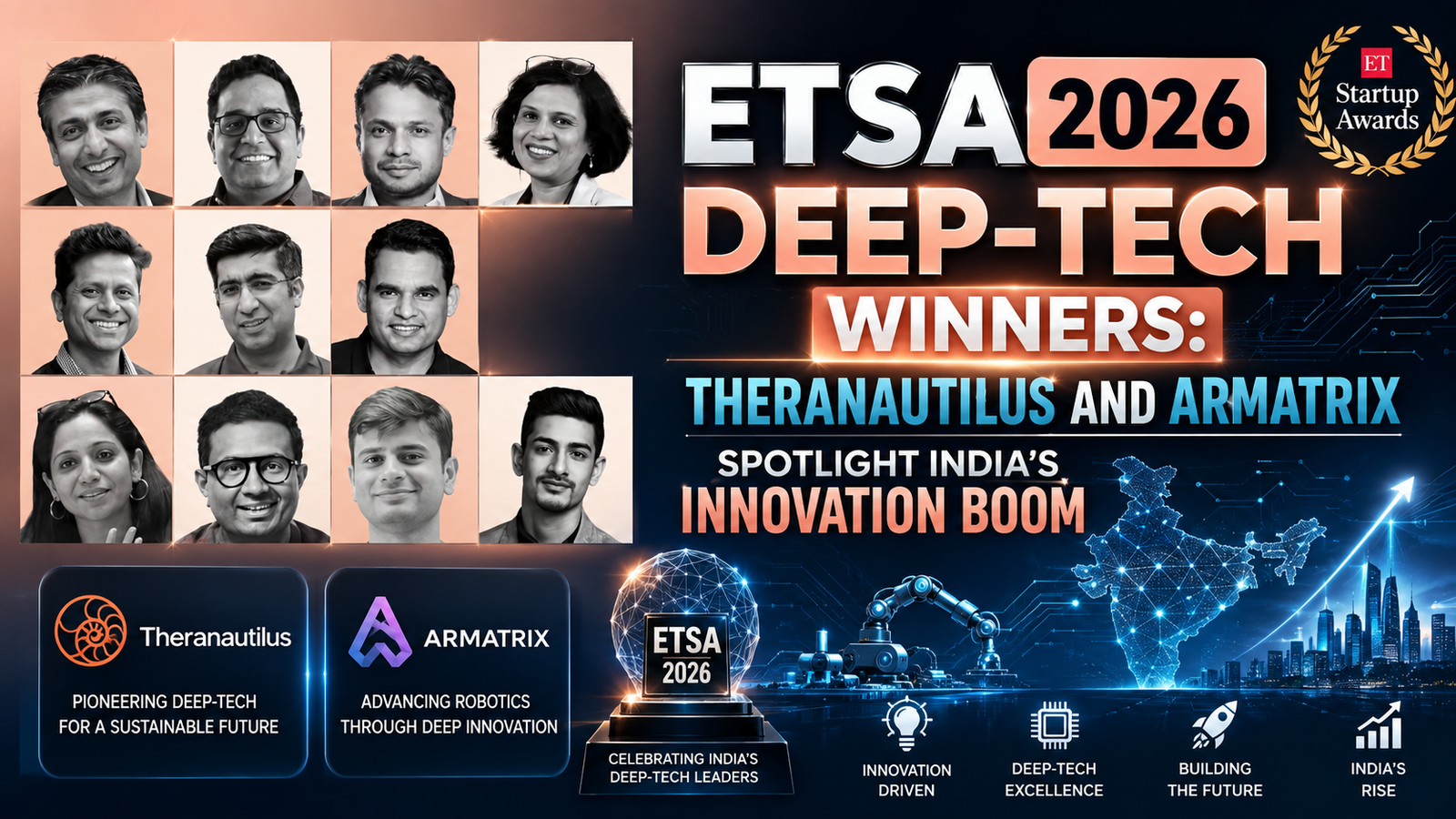
ETSA 2026 Deep-Tech Winners Put India’s Robotics and Innovation Sector in Spotlight
ETSA 2026 deep-tech winners have added another layer of excitement to this year’s Economic Times Startup Awards, highlighting how India’s startup ecosystem is increasingly moving beyond consumer internet businesses and into advanced technology.
Alongside Groww’s recognition as Startup of the Year, two emerging deep-tech ventures, Theranautilus and Armatrix, received major recognition for their work in robotics and innovation.
Theranautilus won the Top Innovator award for its medical micro-robots, while robotics startup Armatrix was named Best on Campus for developing snake-like robots designed for industrial applications.
Their recognition reflects the growing attention being given to startups working on difficult engineering problems with potentially significant real-world applications.
ETSA 2026 Deep-Tech Winners Reflect a Changing Startup Landscape
India’s startup story has traditionally been associated with fintech, e-commerce, food delivery and consumer technology.
That picture is changing.
The rise of deep-tech startups is bringing more attention to areas such as robotics, artificial intelligence, space technology, semiconductors, advanced manufacturing and biotechnology.
The recognition of Theranautilus and Armatrix at ETSA 2026 shows that investors, businesses and the wider startup ecosystem are increasingly interested in companies developing technology that could have long-term industrial and societal impact.
Theranautilus Wins Top Innovator Award
One of the major highlights among the ETSA 2026 deep-tech winners was Theranautilus, which received the Top Innovator recognition.
The startup is working on medical micro-robots designed for targeted treatments.
The concept sits at the intersection of robotics, medicine and advanced engineering.
Instead of relying only on conventional methods of delivering treatments, micro-robotic technology aims to enable highly targeted interventions within the body.
The potential applications make this type of technology particularly interesting because precision is an important challenge in modern medicine.
How Medical Micro-Robots Could Change Treatment
The idea behind medical micro-robots is to create extremely small robotic systems that can potentially navigate within the human body and deliver treatment to specific locations.
Targeted approaches could eventually help reduce unnecessary exposure of healthy tissue to certain treatments.
However, developing such technology is highly complex.
Researchers have to solve challenges related to movement, control, navigation, safety and interaction with biological systems.
This makes Theranautilus’s work an example of the kind of difficult, research-heavy innovation associated with deep-tech startups.
Why Theranautilus’ Recognition Matters
The Top Innovator award is significant because it brings attention to a startup working on technology that requires substantial scientific and engineering expertise.
Deep-tech companies often take longer to develop than conventional software startups.
They may require specialised laboratories, research partnerships, highly skilled teams and extensive testing before their products can reach commercial markets.
Recognition from a major startup award can help increase visibility among investors, industry partners and potential collaborators.
Armatrix Wins Best on Campus
Another notable name among the ETSA 2026 deep-tech winners is Armatrix.
The campus-grown robotics venture won the Best on Campus award for its work on snake-like industrial robots.
The recognition highlights how university and campus ecosystems can serve as important starting points for advanced engineering ventures.
Students and young researchers are increasingly using academic environments to experiment with robotics, artificial intelligence and other emerging technologies.
Some of these projects can eventually evolve into commercial businesses.
What Makes Snake-Like Robots Interesting?
Snake-like robots are designed around a flexible structure that allows them to move through spaces where conventional robots may struggle.
This type of design can potentially be useful in industrial environments where access is difficult or restricted.
Industrial facilities often contain narrow spaces, complex machinery and areas that may be challenging or unsafe for humans to access.
Flexible robotic systems could potentially help with inspection, maintenance and other industrial tasks.
Robotics Has Huge Potential in India
India’s manufacturing sector is becoming increasingly automated.
As companies invest in modern factories and advanced production systems, demand for robotics and automation technologies is likely to increase.
Indian startups have an opportunity to develop solutions specifically suited to local industrial requirements.
This could include robotics for manufacturing, infrastructure inspection, logistics, warehouses and other industrial environments.
Armatrix’s recognition highlights the potential of young Indian companies to contribute to this transition.
Deep-Tech Is Becoming a Bigger Part of India’s Startup Story
The success of ETSA 2026 deep-tech winners points to a broader trend.
India is developing startups that are attempting to solve problems involving complex technology rather than simply creating digital platforms.
This includes companies working on:
- Artificial intelligence
- Robotics
- Semiconductors
- Space technology
- Biotechnology
- Advanced manufacturing
- Climate technology
These sectors often require significant technical expertise and longer development timelines.
But successful companies in these areas could eventually create technologies with global applications.
The Importance of Awards for Deep-Tech Startups
Recognition can be particularly valuable for early-stage deep-tech companies.
Unlike consumer startups, many deep-tech businesses are difficult to explain through a simple product demonstration.
Their technologies may involve complex scientific concepts, specialised hardware or years of research.
Awards can help these companies communicate their credibility to a broader audience.
They can also provide exposure to investors and potential industry partners who may not otherwise discover early-stage deep-tech ventures.
India’s Campus Innovation Ecosystem
Armatrix’s Best on Campus recognition also highlights the growing importance of student entrepreneurship.
Universities are no longer simply places for academic research.
They are increasingly becoming environments where students experiment with robotics, AI, engineering and entrepreneurship.
Access to laboratories, professors, technical communities and other students can help young founders develop prototypes before entering the commercial market.
A stronger connection between universities and industry could accelerate this process even further.
Deep-Tech Startups Face Different Challenges
While the potential is enormous, deep-tech entrepreneurship is not easy.
Hardware development requires capital, manufacturing capabilities and extensive testing.
Medical technologies face additional regulatory and safety requirements.
Robotics companies need to prove that their systems can work reliably in real-world environments.
This means deep-tech startups often need more time and resources than software-first companies.
Access to patient capital and strong research partnerships can therefore make a major difference.
Why Investors Are Watching Deep-Tech
Investors are increasingly interested in deep-tech because successful technologies can create strong competitive advantages.
A company with proprietary technology, specialised expertise or difficult-to-replicate engineering capabilities may have a stronger barrier to entry than a conventional software business.
At the same time, the risks are also higher.
Technology may take longer to develop, commercialisation may be uncertain and significant capital may be required before meaningful revenue is generated.
The challenge for investors is identifying startups that can successfully move from research and prototypes to scalable commercial products.
A Strong Signal for India’s Innovation Ecosystem
The recognition of Theranautilus and Armatrix sends an encouraging signal to India’s deep-tech community.
It shows that innovation is being recognised across different stages and sectors.
Theranautilus represents highly specialised medical robotics, while Armatrix demonstrates the potential of campus-driven industrial innovation.
Their stories are very different, but both highlight the same broader trend: Indian startups are increasingly attempting to build technology rather than simply build platforms around existing technology.
What Comes Next for Theranautilus and Armatrix?
The next challenge for both startups will be turning innovation into scalable real-world applications.
For Theranautilus, continued development, validation and the appropriate regulatory journey will be critical as medical robotics moves closer to practical applications.
For Armatrix, proving reliability and commercial value in industrial environments will be key to scaling its technology.
If they can successfully move from innovation to widespread adoption, both companies could become examples of India’s emerging deep-tech success stories.
India’s Deep-Tech Opportunity
India has several advantages that could support the growth of its deep-tech ecosystem.
The country has a large engineering talent pool, a growing startup culture and an expanding network of research institutions.
Government initiatives and increasing private investment are also creating more opportunities for technology-focused businesses.
However, continued progress will require long-term funding, stronger university-industry collaboration and better access to advanced research and manufacturing infrastructure.
The ETSA 2026 deep-tech winners demonstrate what can happen when technical innovation receives wider recognition.
Their success could encourage more students, researchers and entrepreneurs to pursue ambitious technology ventures.
Frequently Asked Questions (FAQs)
1. Who are the ETSA 2026 deep-tech winners?
Among the notable ETSA 2026 deep-tech winners are Theranautilus, which won Top Innovator, and Armatrix, which won Best on Campus.
2. What award did Theranautilus win?
Theranautilus won the Top Innovator award at the ET Startup Awards 2026.
3. What does Theranautilus develop?
Theranautilus is developing medical micro-robots designed for targeted treatments, combining robotics and medical technology.
4. What award did Armatrix receive?
Armatrix won the Best on Campus award at ETSA 2026.
5. What does Armatrix develop?
Armatrix is developing snake-like industrial robots designed for applications in challenging industrial environments.
6. Why is deep-tech important for India?
Deep-tech startups can help India build advanced capabilities in areas such as robotics, AI, semiconductors, biotechnology, space technology and advanced manufacturing.
7. Why are deep-tech startups different from conventional startups?
Deep-tech companies often require significant research, specialised talent, hardware development and longer timelines before their technology becomes commercially scalable.
8. Can medical micro-robots change healthcare?
Medical micro-robotics has the potential to enable more targeted treatments, although technologies in this field require extensive development, validation and appropriate regulatory approval before widespread clinical use.
9. Why is campus innovation important?
Universities provide young innovators with access to research, technical expertise and laboratories, making them an important environment for developing early-stage deep-tech technologies.
10. What do the ETSA 2026 awards mean for India’s startup ecosystem?
The recognition of startups such as Theranautilus and Armatrix highlights the growing importance of deep-tech innovation and shows that India’s startup ecosystem is expanding beyond traditional consumer and internet businesses.