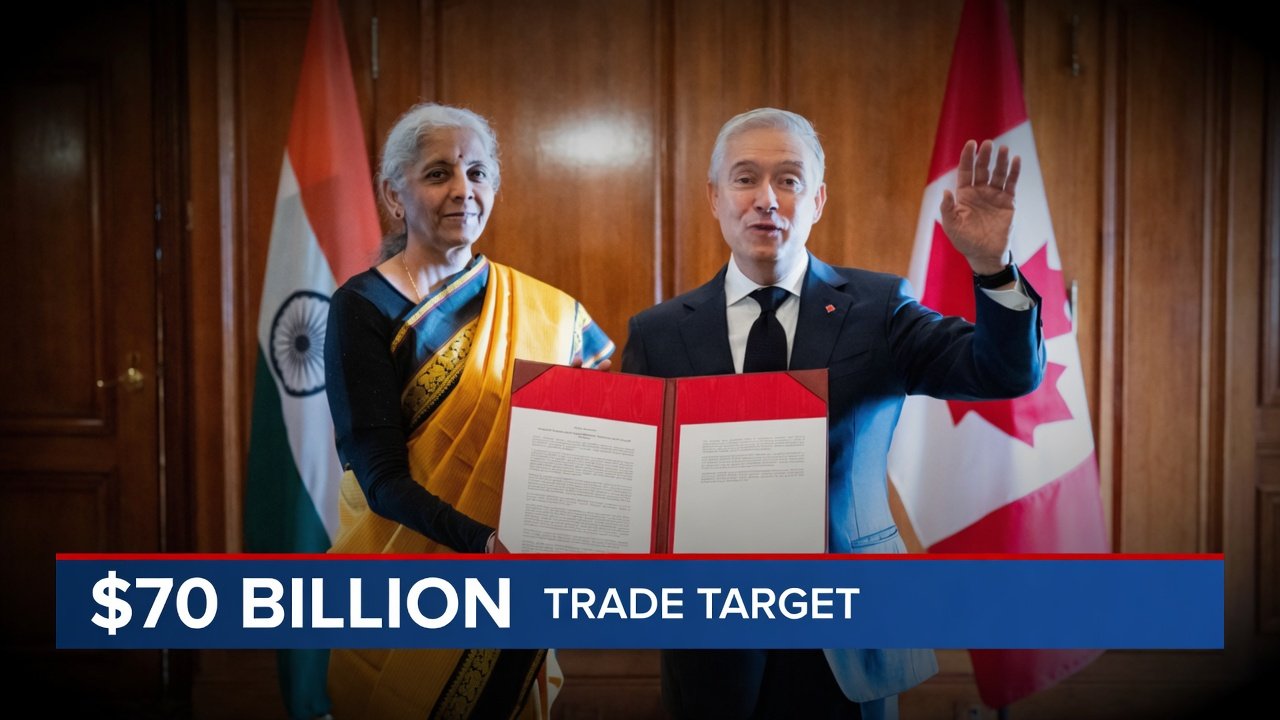
Canada Sets $70 Billion India Trade Target by 2030, Highlights $100 Billion Investment Footprint
Canada has set an ambitious Canada India trade target of $70 billion over the next five years, as both countries work to deepen their economic relationship and advance negotiations for a Comprehensive Economic Partnership Agreement (CEPA).
Canadian International Trade Minister Maninder Sidhu said Canada and India are looking to increase bilateral trade from around $30 billion to $70 billion annually by 2030. He also highlighted Canada’s substantial investment presence in India, saying Canadian investors have already deployed more than $100 billion in the country.
Canada and India Target $70 Billion in Trade
The proposed target would more than double current two-way trade between the two countries.
According to Canada’s official figures, two-way goods and services trade between Canada and India reached $30.4 billion in 2025, while merchandise trade stood at $13.6 billion. Canada is seeking to raise total bilateral trade to $70 billion annually by 2030.
The target forms part of a broader effort by Canada to diversify its international trade relationships and expand commercial ties beyond its traditional dependence on the United States.
For India, the expanded relationship could create additional opportunities in areas including energy, critical minerals, technology, agriculture, services and investment.
Maninder Sidhu Highlights Canadian Investment in India
During recent discussions, Trade Minister Maninder Sidhu highlighted Canada’s existing financial presence in the Indian economy.
Sidhu described Canada as the largest collective investor in India, with more than US$100 billion invested. Canadian pension funds and other institutional investors have significant exposure to Indian infrastructure and other sectors.
Canadian Prime Minister Mark Carney previously said that total direct and indirect Canadian investment in India had surpassed $110 billion in 2024, with Canadian pension funds playing an important role in that investment relationship.
The investment footprint provides a financial foundation for the countries’ efforts to expand trade and commercial cooperation.
Canada-India CEPA Negotiations
A major part of the economic agenda is the proposed Canada-India Comprehensive Economic Partnership Agreement.
Negotiations have progressed through multiple rounds, with both governments aiming to conclude the talks by the end of 2026. Canada has said the agreement is intended to support the goal of expanding bilateral trade to $70 billion annually by 2030.
The proposed CEPA is expected to cover areas including goods and services, investment, agriculture and agri-food, digital trade, mobility and sustainable development.
An agreement could establish clearer market-access conditions for businesses in both countries, although the final terms will depend on the negotiations.
Current Canada-India Trade Picture
The existing trade relationship covers a broad range of goods and services.
In 2025, Canada’s merchandise exports to India were valued at approximately $3.9 billion, with vegetables, mineral fuels and oils, and wood pulp among the leading exports.
India’s merchandise exports to Canada were significantly higher at approximately $9.7 billion, with precious stones and metals, machinery and pharmaceutical products among the major categories.
Services are another important part of the relationship. Canada’s service exports to India were valued at $15.2 billion in 2025, while service imports from India reached $4.5 billion. Education-related travel represented a significant portion of Canada’s service exports to India.
Energy and Critical Minerals Could Drive Growth
Energy and critical minerals are emerging as important areas in the expanding economic relationship.
Canada has significant resources in energy and critical minerals, while India’s growing economy is expected to require additional energy and industrial inputs.
During Prime Minister Carney’s March 2026 visit to India, the two countries announced a Strategic Energy Partnership covering areas including LNG, LPG, uranium, solar and hydrogen. They also agreed to strengthen cooperation on critical minerals and energy supply chains.
A landmark agreement involving Canada’s Cameco and the Indian government also covers the supply of nearly 22 million pounds of uranium to India between 2027 and 2035.
Technology and New Investment Opportunities
The expanding relationship is not limited to traditional commodities.
Canada and India have identified technology, artificial intelligence, advanced manufacturing, aerospace and clean technologies as areas with potential for greater commercial cooperation.
During his recent India engagements, Sidhu met representatives of companies including Mahindra & Mahindra, Bajaj Integrated Health System, JSW Group and CAE to discuss collaboration in sectors such as life sciences, clean technology, energy transition and aerospace.
Greater investment and trade flows could give companies in both countries additional opportunities to enter new markets and develop partnerships.
Canada Plans Trade Mission to India
Canada is also preparing a new trade mission as part of its effort to expand commercial ties.
Sidhu is scheduled to lead a Team Canada Trade Mission to India from October 12 to 17, 2026. The mission is intended to help Canadian businesses explore opportunities in India and strengthen long-term trade and investment relationships.
The mission comes as CEPA negotiations move toward their stated end-of-2026 target.
What the $70 Billion Target Means
The Canada India trade target represents a significant expansion from current trade levels.
Reaching $70 billion annually would require substantial growth in both goods and services trade, along with increased commercial activity across sectors such as energy, critical minerals, technology, agriculture and investment.
The target is also part of Canada’s broader trade-diversification strategy. Canada’s official policy documents identify India as an important partner as the country seeks to expand trade relationships in the Indo-Pacific and increase exports to markets beyond the United States.
Whether the $70 billion objective is achieved will depend on the outcome of CEPA negotiations, market-access arrangements, investment activity and the ability of businesses in both countries to expand commercial ties.
FAQs
1. What is Canada’s trade target with India?
Canada and India have set a shared goal of increasing bilateral trade to $70 billion annually by 2030.
2. Who announced the $70 billion India trade target?
Canadian International Trade Minister Maninder Sidhu highlighted the target during recent discussions on expanding Canada-India commercial relations.
3. What is the current Canada-India trade value?
Two-way goods and services trade between Canada and India reached approximately $30.4 billion in 2025.
4. How much has Canada invested in India?
Canadian officials have cited more than US$100 billion in Canadian investment in India. Canada’s prime minister has separately said total direct and indirect Canadian investment exceeded $110 billion in 2024.
5. What is the Canada-India CEPA?
The Comprehensive Economic Partnership Agreement is a proposed trade agreement intended to expand and structure economic ties between Canada and India across goods, services, investment and other areas.
6. When are Canada and India aiming to conclude CEPA negotiations?
Both countries have stated an objective of concluding the negotiations by the end of 2026.
7. Which sectors could benefit from stronger Canada-India trade?
Key areas include energy, critical minerals, agriculture, technology, AI, aerospace, clean technologies, pharmaceuticals and services.
8. What does Canada currently export to India?
Major Canadian merchandise exports include vegetables, mineral fuels and oils, and wood pulp.
9. What does India export to Canada?
Major Indian merchandise exports to Canada include precious stones and metals, machinery and pharmaceutical products.
10. Is Canada planning a new trade mission to India?
Yes. Canadian International Trade Minister Maninder Sidhu is scheduled to lead a Team Canada Trade Mission to India from October 12 to 17, 2026.