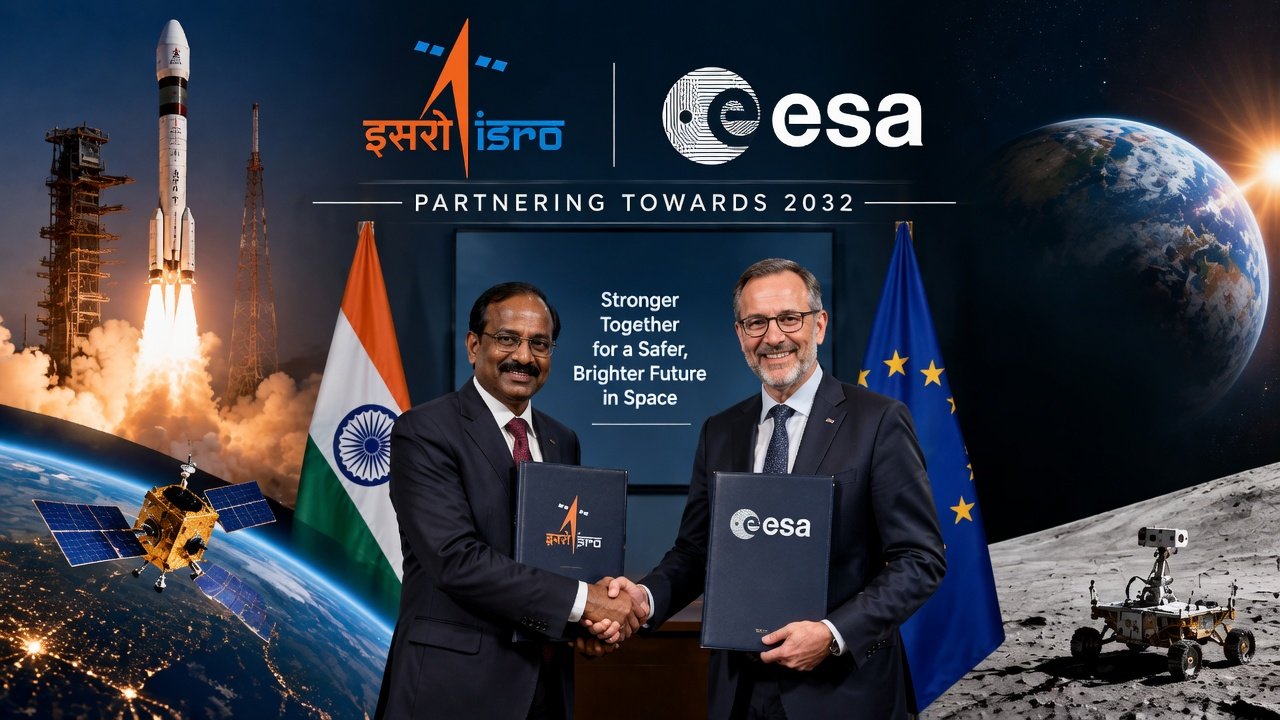
ISRO and ESA Extend Space Cooperation Until 2032
The Indian Space Research Organisation (ISRO) and the European Space Agency (ESA) have extended their long-standing space cooperation agreement for another five years, taking the framework through January 8, 2032.
The renewal was formalised through an exchange of letters signed in Paris on September 10, 2026, on the sidelines of the International Space Summit. The agreement, originally brought into force in January 2002, provides a broad framework for cooperation between India and Europe across multiple areas of space activity.
Scope of ISRO-ESA Cooperation Expands
The renewed agreement does more than extend the existing framework. It also broadens the areas in which ISRO and ESA can cooperate.
The updated agreement specifically adds:
- Human space exploration
- Robotic space exploration
- Space weather
- Sustainability of outer space activities
Existing cooperation in areas such as space science, Earth observation and mission operations will continue under the expanded framework.
The broader scope reflects the growing focus of both space agencies on exploration beyond traditional satellite and Earth-observation programmes.
Chandrayaan-5 Connection Needs Clarification
The renewed ISRO-ESA agreement comes at a time when India is preparing several major lunar and exploration missions, including Chandrayaan-5, also known as the Lunar Polar Exploration Mission (LUPEX).
However, Chandrayaan-5 is officially a joint ISRO-JAXA mission, not an ISRO-ESA mission. ISRO’s annual report identifies Chandrayaan-5/LUPEX as a collaboration between India and Japan, with the mission focused on studying lunar polar volatiles. The mission received financial sanction in March 2025, while the Phase-B Implementation Arrangement between ISRO and JAXA was signed in August 2025.
Therefore, the renewed ISRO-ESA framework creates opportunities for future cooperation but does not itself announce ESA’s participation in Chandrayaan-5.
Chandrayaan-5 and JAXA Partnership
Chandrayaan-5/LUPEX is being jointly developed by ISRO and the Japan Aerospace Exploration Agency (JAXA).
The mission is designed to conduct in-situ studies of lunar polar volatiles and is expected to deploy a lander and rover for scientific investigations.
Recent technical discussions between Indian and Japanese teams have focused on mission interfaces, payloads and scientific objectives. The mission is currently planned for a future launch, with reports indicating a target around 2028.
ESA’s renewed cooperation with ISRO should therefore be viewed as a broader framework for future space activities rather than a specific agreement for Chandrayaan-5.
ISRO and ESA Have a Long Space Partnership
India and Europe have maintained space cooperation for decades.
ESA said the relationship dates back more than two decades under the Cooperative Agreement that entered into force in 2002. The two agencies have worked together across Earth observation, satellite navigation, space science and mission operations support.
In March 2026, ISRO and ESA also signed a separate arrangement covering joint calibration and validation activities and scientific studies related to Earth-observation missions. ISRO described the agreement as another step in cooperation that has roots stretching back to 1978.
Human Spaceflight Cooperation
The renewed framework also builds on more recent cooperation in human spaceflight.
In May 2025, ISRO and ESA signed a Joint Statement of Intent focused on cooperation in human space exploration. The statement covered areas including spacecraft interoperability, astronaut training, analogue missions and research activities in low Earth orbit.
The agencies have also discussed potential future cooperation involving India’s planned Bharatiya Antariksh Station and European astronaut flight opportunities.
Earlier, in December 2024, ESA and ISRO signed an agreement under which ESA would provide ground-segment support for India’s Gaganyaan human-spaceflight programme.
Space Weather Added to Cooperation Framework
One of the newly recognised areas under the renewed agreement is space weather.
Space weather refers to changes in the space environment driven primarily by solar activity. Solar storms and related phenomena can affect satellites, communication systems, navigation services and other space-based infrastructure.
Greater cooperation in this field could support scientific research, monitoring capabilities and the development of technologies designed to understand and manage space-weather effects.
Focus on Sustainable Use of Outer Space
The updated agreement also recognises the growing importance of sustainability in outer-space activities.
As the number of satellites and commercial space missions increases globally, space agencies are paying greater attention to issues such as orbital congestion, space debris and responsible use of the space environment.
The inclusion of sustainability in the renewed ISRO-ESA framework provides another area for information sharing, research and potential joint activities.
ESA and ISRO Can Pursue Future Joint Missions
The renewed agreement provides a framework for the agencies to explore additional cooperation rather than automatically committing them to specific missions.
ESA and ISRO have already demonstrated cooperation through Earth-observation activities, satellite navigation, ground-station support and human-spaceflight initiatives.
The broader framework could provide a foundation for future scientific and technological projects as both agencies expand their exploration programmes.
India’s Expanding International Space Partnerships
The ISRO-ESA agreement comes amid a broader expansion of India’s international space partnerships.
ISRO’s 2025–26 annual report notes that India and ISRO have signed space cooperation documents with space agencies from dozens of countries and with several multinational organisations. These partnerships cover areas including space technology, Earth observation, human spaceflight and scientific exploration.
The renewed ESA relationship adds to this network while giving India and Europe a framework for cooperation across both established and emerging space activities.
What the ISRO-ESA Pact Means for Future Space Exploration
The extension until January 2032 provides long-term continuity to India-Europe space cooperation while expanding its scope into human and robotic exploration, space weather and space sustainability.
For India, the partnership creates opportunities to access European expertise and infrastructure across selected areas of space science and exploration. For ESA, continued cooperation with ISRO provides a framework for working with one of the world’s major space agencies on future exploration and scientific initiatives.
While the agreement does not specifically make ESA a partner in Chandrayaan-5, it establishes a broader platform for future collaboration as India and Europe expand their ambitions in space.
Frequently Asked Questions
1. What is the ISRO-ESA space cooperation agreement?
It is a framework governing cooperation between ISRO and the European Space Agency across areas including space science, Earth observation, mission operations and exploration.
2. Until when has the ISRO-ESA agreement been extended?
The agreement has been extended until January 8, 2032.
3. When was the renewed ISRO-ESA agreement signed?
The exchange of letters was signed in Paris on September 10, 2026, during the International Space Summit.
4. What new areas are included in the renewed agreement?
The expanded framework includes space weather, human exploration, robotic exploration and sustainability of outer-space activities.
5. Is ESA a partner in Chandrayaan-5?
No. Chandrayaan-5/LUPEX is a joint mission between ISRO and Japan’s JAXA.
6. What is Chandrayaan-5?
Chandrayaan-5, also known as LUPEX, is a joint India-Japan lunar mission designed to study lunar polar volatiles in situ.
7. Has ISRO worked with ESA before?
Yes. ISRO and ESA have collaborated for many years across areas including Earth observation, navigation, space science and mission operations.
8. Are ISRO and ESA cooperating on human spaceflight?
Yes. The agencies signed a Joint Statement of Intent in 2025 covering areas such as astronaut training, spacecraft interoperability and human space exploration.
9. Will the agreement support space-weather research?
Yes. Space weather has been specifically added to the expanded areas of cooperation.
10. Why is the ISRO-ESA agreement important?
The renewed framework gives India and Europe a longer-term basis for cooperation in space science, exploration, technology, space weather and sustainable use of outer space through 2032.