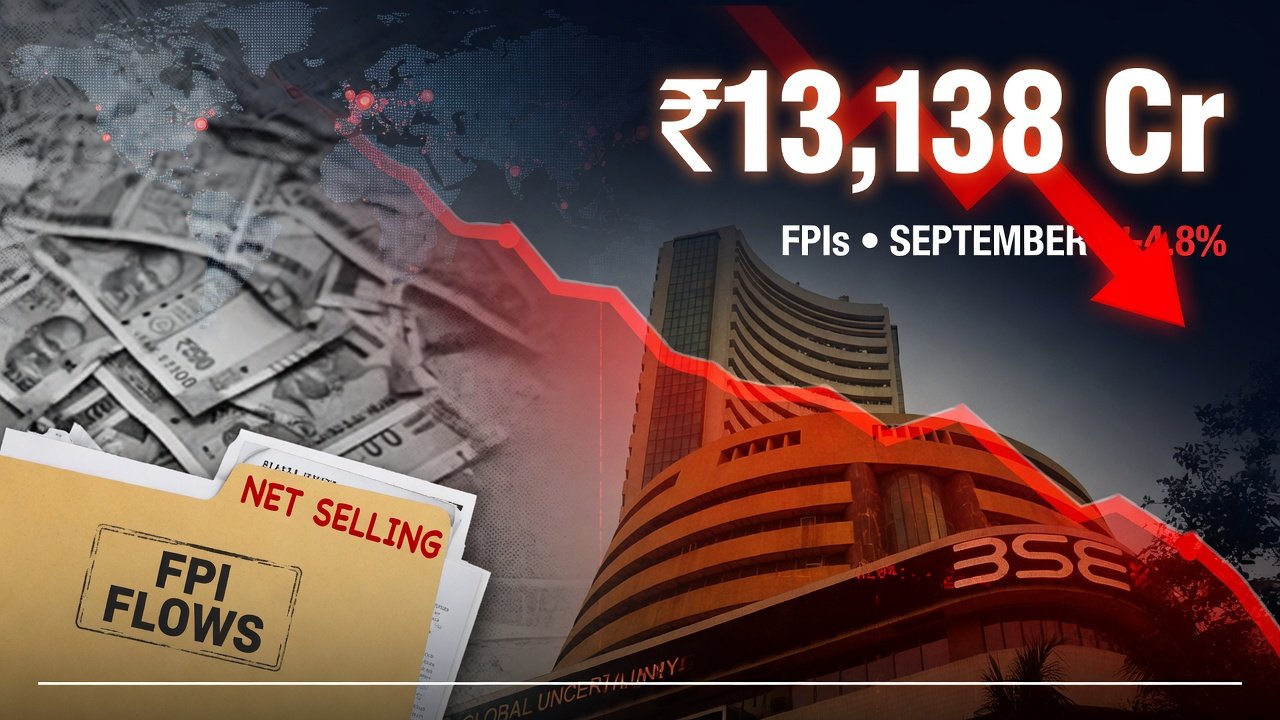
FPIs Pull Out ₹13,138 Crore From Indian Equities in September Amid Global Uncertainty
Foreign Portfolio Investors (FPIs) have turned sellers in the Indian equity market once again, withdrawing ₹13,138 crore from Indian equities during the first half of September 2026. The heavy selling comes amid heightened global uncertainty, rising crude oil prices, elevated US bond yields and a stronger US dollar, all of which have reduced investor appetite for emerging-market assets.
The latest outflow marks a sharp reversal from the buying trend seen in the previous two months. Foreign investors had returned to Indian equities in July and August, but renewed global concerns have prompted them to reduce exposure in September.
The development is being closely watched because FPI flows can have a significant influence on market liquidity, investor sentiment and short-term movements in major Indian equity indices.
Why Are FPIs Selling Indian Equities?
Several global factors are contributing to the latest FPI selling.
One of the biggest concerns is the sharp rise in crude oil prices. Higher oil prices can create additional pressure for India because the country remains heavily dependent on imported crude. A sustained increase in energy costs can raise the import bill and add to inflationary pressures.
At the same time, US bond yields have risen, making dollar-denominated fixed-income assets relatively more attractive to global investors. When yields rise in developed markets, investors can become more cautious about taking additional risk in emerging markets such as India.
The strengthening of the US dollar is another factor influencing global capital flows.
Global Tensions Add to Market Pressure
Geopolitical tensions have further complicated the global investment environment.
The ongoing conflict involving the United States and Iran has contributed to volatility in energy markets, with crude prices moving sharply higher. Reuters reported that Brent crude recently reached a four-month high near $110 per barrel, while global equity funds also experienced significant outflows as investors reacted to concerns about inflation and interest rates.
For emerging markets, these developments can create a difficult combination of higher energy costs, tighter global financial conditions and weaker risk appetite.
India has also experienced pressure on its currency. The rupee recently moved beyond the ₹95-per-dollar level as crude prices climbed and geopolitical tensions intensified.
FPI Selling Reverses July and August Buying
The September outflow comes after foreign investors had turned net buyers in the previous two months.
According to market reports, FPIs invested approximately ₹20,200 crore in July and ₹29,630 crore in August. The return of foreign buying during those months had provided support to Indian equities after a prolonged period of selling pressure.
The reversal in September therefore represents a notable change in investor behaviour.
However, the latest selling does not necessarily mean that foreign investors have completely abandoned Indian markets. FPI flows can change rapidly depending on global interest rates, currency movements, commodity prices, valuations and geopolitical developments.
How Higher Crude Prices Affect India
Crude oil remains one of the most important external variables for India’s economy.
When international oil prices rise sharply, India’s import bill can increase. Higher input costs can put pressure on companies across sectors, while persistent energy inflation can also complicate monetary policy decisions.
Recent market volatility has reflected these concerns. On September 9, the Sensex fell more than 800 points, while the Nifty also declined as crude prices moved above $100 a barrel and the rupee weakened.
For foreign investors, a combination of falling stock prices and currency depreciation can make Indian assets less attractive in dollar terms.
US Bond Yields Remain a Key Factor
Another important factor behind the FPI outflow is the rise in US bond yields.
Global investors frequently compare the potential returns available across different markets. When US Treasury yields increase, the relative attractiveness of riskier assets in emerging economies can decline.
Higher yields can also strengthen the US dollar as international investors seek dollar-denominated assets.
This creates additional pressure on emerging-market currencies and equities, including those in India.
Domestic Investors Provide Some Support
While foreign investors have been selling, domestic institutional investors can help absorb some of the selling pressure.
Indian mutual funds, insurance companies and other domestic institutions have become increasingly important participants in the country’s equity markets. Their buying activity can provide a degree of stability when global investors reduce exposure.
This means FPI selling does not automatically translate into a prolonged market decline.
The eventual direction of Indian equities will depend on a combination of foreign flows, domestic liquidity, corporate earnings, valuations and macroeconomic conditions.
India Still Attracts Long-Term Foreign Capital
Despite the equity-market selling, foreign investment into India has not completely stopped.
Data reported through September 12 showed that FPI investment through the primary market remained positive, with approximately ₹1,336 crore invested through the primary market during September. This indicates that foreign investors continue to participate in selected new issues even as they sell shares through exchanges.
This distinction is important because selling listed equities does not necessarily mean investors have lost interest in India as a long-term investment destination.
Different investors can have different strategies, and capital can shift between sectors, asset classes and markets depending on valuations and global conditions.
What Could Happen Next?
The direction of FPI flows will likely depend heavily on developments in the global economy.
Investors will closely watch crude oil prices, US Treasury yields, the US dollar, geopolitical developments and central-bank policy expectations.
If oil prices remain elevated and global bond yields continue to rise, foreign investors could remain cautious toward emerging markets.
On the other hand, any easing of geopolitical tensions, stabilization in crude prices or improvement in global risk appetite could help reverse some of the recent selling.
Domestic factors will also remain important. Corporate earnings, economic growth, interest rates and India’s long-term growth outlook could influence whether global investors return to Indian equities.
What Does the FPI Outflow Mean for Retail Investors?
For retail investors, heavy FPI selling can increase short-term market volatility.
Foreign investors are large participants in Indian equity markets, so significant buying or selling can influence market sentiment and liquidity. However, retail investors should not interpret every FPI outflow as a signal that the entire market is headed for a sustained decline.
FPI flows are only one part of the market picture.
Investors also need to consider company fundamentals, valuations, earnings growth and their own investment horizon rather than reacting solely to daily foreign-investor activity.
Frequently Asked Questions
How much money have FPIs withdrawn from Indian equities in September 2026?
FPIs withdrew ₹13,138 crore from Indian equities during the first half of September 2026, according to market data reported on September 13.
Why are FPIs selling Indian stocks?
The recent selling has been linked to global uncertainty, higher crude oil prices, rising US bond yields, a stronger US dollar and geopolitical tensions.
Did FPIs buy Indian equities before September?
Yes. FPIs were net buyers in July and August, investing approximately ₹20,200 crore in July and ₹29,630 crore in August before turning sellers again in September.
How do higher crude oil prices affect Indian stocks?
Higher crude prices can increase India’s import bill and inflationary pressures. They can also put pressure on the rupee and corporate costs, potentially affecting investor sentiment toward Indian equities.
Does FPI selling mean the Indian stock market will crash?
Not necessarily. FPI selling can increase volatility and create short-term pressure, but market performance also depends on domestic institutional buying, corporate earnings, economic growth, valuations and other factors.
Are foreign investors still investing in India?
Yes. Despite selling listed equities, foreign investors have continued to participate in India’s primary market. FPI investment through the primary market was reported at around ₹1,336 crore through September 12.