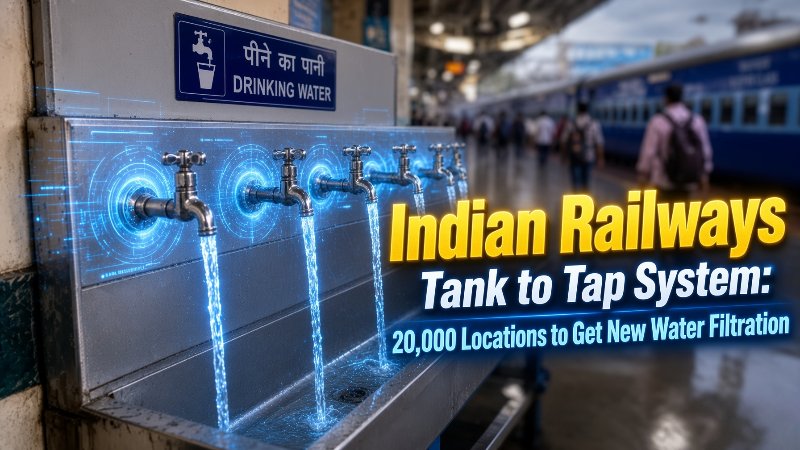
Indian Railways Tank to Tap System to Be Installed at 20,000 Locations
Indian Railways Tank to Tap water filtration system is set for a major expansion across the railway network following concerns over the quality of drinking water available at stations.
The Railways plans to introduce the “Tank to Tap” water filtration system at around 20,000 locations, along with upgraded water coolers and monitoring systems. The move follows a review led by Railway Minister Ashwini Vaishnaw after a recent CAG report highlighted concerns over drinking-water quality at railway stations.
The initiative is aimed at ensuring that passengers and railway staff have access to safer and more reliable drinking water.
CAG Report Flags E. Coli in Railway Station Water
The action follows findings highlighted in a report by the Comptroller and Auditor General of India (CAG).
According to reports on the CAG findings, water samples collected from water coolers at eight railway stations were found to contain E. coli and coliform bacteria. The findings raised concerns over the safety of drinking water being provided to passengers.
The issue is particularly important because railway stations serve millions of passengers every day, many of whom depend on station water facilities during their journeys.
What Is the Tank to Tap System?
The proposed Tank to Tap system is designed to improve water quality by strengthening filtration and monitoring between the water-storage stage and the point where passengers receive drinking water.
The planned upgrade includes advanced water coolers, filtration systems and water-quality monitoring mechanisms.
The objective is to reduce the possibility of contamination and provide cleaner drinking water at railway facilities.
Why Is Safe Drinking Water Important at Railway Stations?
Railway stations experience heavy passenger movement throughout the year.
Passengers often use free drinking-water facilities, particularly during long-distance journeys and periods of extreme weather.
Any contamination in these facilities can therefore become a significant public-health concern.
Children, elderly passengers and people travelling long distances may be particularly dependent on accessible drinking-water facilities.
The latest findings have consequently put railway station water quality under renewed scrutiny.
Railways Moves Toward Nationwide Water Quality Upgrade
The proposed rollout is not limited to a small number of major stations.
The Railways is planning the Tank to Tap system across approximately 20,000 locations, making it one of the larger drinking-water infrastructure upgrades across the network.
The plan is expected to combine filtration, improved cooling equipment and regular monitoring rather than relying only on conventional water-distribution arrangements.
This approach could help Railways identify water-quality problems more quickly and take corrective action.
Railway Stations Have Previously Used Water Treatment Systems
Providing safe drinking water at railway stations is not a new priority for Indian Railways.
Railway authorities have previously issued instructions for treated drinking water and regular quality testing at stations. The Railways has also used water vending machines, RO-based systems and packaged drinking water as part of its efforts to provide potable water.
Earlier government information also showed that drinking water at stations was required to meet prescribed quality standards, with testing carried out as part of the monitoring process.
The new Indian Railways Tank to Tap initiative represents a further attempt to strengthen this infrastructure.
E. Coli Contamination Raises Health Concerns
The presence of E. coli in drinking water is considered an important indicator of possible contamination.
Certain strains of E. coli can cause gastrointestinal illness, while contaminated water can pose a greater risk to vulnerable individuals.
This is why regular testing and effective filtration are essential for public drinking-water facilities.
The CAG findings have therefore highlighted the need for stronger monitoring rather than relying solely on periodic corrective action.
Focus on Filtration and Monitoring
One of the key features of the new initiative is that Railways is looking at both filtration and monitoring.
Simply installing a water cooler may not be sufficient if the water entering the system is contaminated or if the equipment is not properly maintained.
The proposed Tank to Tap approach is intended to cover the process more comprehensively, from storage and filtration to the final point of supply.
This could make it easier for railway authorities to maintain consistent water-quality standards across stations.
What Does This Mean for Railway Passengers?
For passengers, the most visible change could be the availability of upgraded drinking-water facilities at stations.
If implemented effectively, the new system could provide cleaner and more dependable drinking water while reducing concerns over contamination.
Passengers may also benefit from better monitoring and maintenance of water facilities.
The success of the programme, however, will ultimately depend on regular testing, proper maintenance and timely action when contamination is detected.
Ashwini Vaishnaw Orders Action After Review
Railway Minister Ashwini Vaishnaw has directed the Railways to take corrective measures following the concerns raised over drinking-water quality.
The review has resulted in the plan to introduce the Tank to Tap system across around 20,000 locations.
The move signals that drinking-water quality is being treated as an important passenger-amenity and public-health issue.
What Happens Next?
The Railways will now have to implement the planned filtration and monitoring infrastructure across the identified locations.
The effectiveness of the programme will depend on factors such as installation quality, regular water testing, equipment maintenance and quick response to contamination.
The CAG findings could also encourage railway authorities to strengthen inspections and monitoring at other stations.
Final Thoughts
The Indian Railways Tank to Tap initiative is a significant step toward improving drinking-water facilities across the country’s railway network.
The decision comes after CAG findings highlighted E. coli and coliform contamination in water samples from eight railway stations, raising concerns about passenger safety.
With the proposed system expected to cover around 20,000 locations, Railways is looking to improve filtration, water coolers and monitoring on a much larger scale.
For millions of passengers who depend on railway drinking-water facilities, the success of the programme could make a meaningful difference.
The key now will be ensuring that the new infrastructure is not only installed but also regularly tested, properly maintained and consistently monitored.
Frequently Asked Questions
What is the Indian Railways Tank to Tap system?
The Indian Railways Tank to Tap system is a planned water-filtration and monitoring upgrade designed to improve the quality of drinking water supplied at railway locations.
How many railway locations will get the Tank to Tap system?
The Railways plans to introduce the system at approximately 20,000 locations across the network.
Why is Indian Railways introducing this system?
The initiative follows concerns over drinking-water quality highlighted in a recent CAG report, including the detection of E. coli and coliform bacteria in water samples from several railway stations.
What did the CAG report find?
Reports on the CAG findings said that water samples from water coolers at eight railway stations were found to contain E. coli and coliform bacteria.
Who ordered the Tank to Tap water upgrade?
Railway Minister Ashwini Vaishnaw reviewed the issue and directed corrective measures, including the planned Tank to Tap filtration rollout.
Is E. coli in drinking water dangerous?
Certain types of E. coli can cause illness, particularly gastrointestinal infections. Its presence in drinking water can also indicate possible contamination, making testing and treatment important.
Will the system be installed only at major railway stations?
No. The planned initiative is expected to cover approximately 20,000 locations, indicating a wider network-level upgrade rather than a programme limited to a few major stations.
How can railway passengers benefit from the new system?
The upgraded filtration, cooling and monitoring infrastructure is intended to provide passengers with safer and more reliable drinking water at railway facilities.