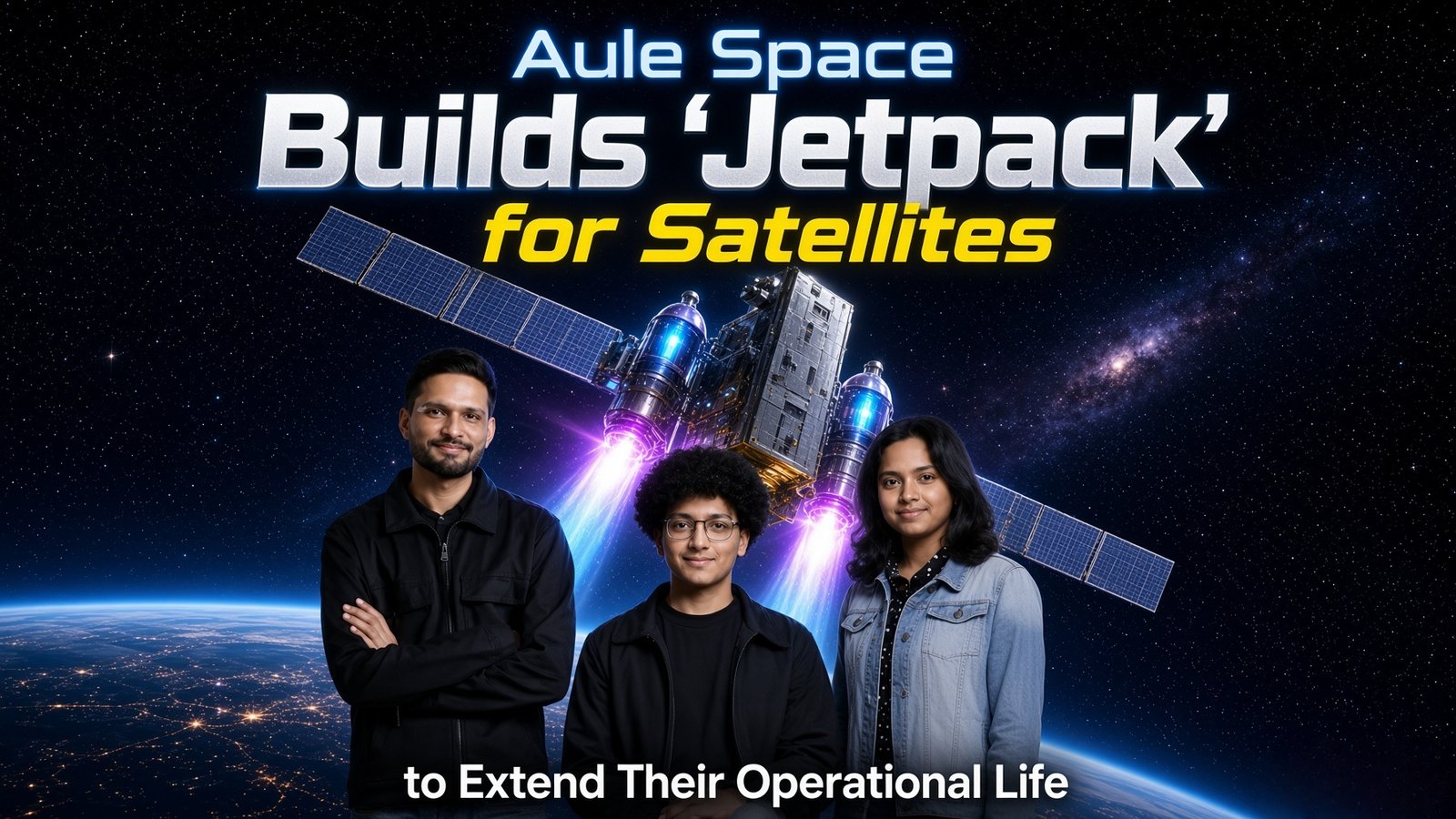
Aule Space Builds ‘Jetpack’ for Satellites
Bengaluru-based spacetech startup Aule Space, co-founded by Jay Panchal, is working on a technology that could help extend the operational life of satellites that are nearing the end of their missions.
The company is developing an in-space propulsion system that can effectively work like a “jetpack for satellites”, allowing a servicing spacecraft to dock with an existing satellite and provide additional propulsion.
The idea is similar to giving a vehicle additional fuel when it is running out of fuel on the road. Instead of allowing a satellite to become unusable once its onboard propellant is depleted, the technology could potentially give it additional operational years.
Why Do Satellites Stop Working?
Satellites can remain technically functional for many years, but their missions are often limited by the amount of propellant available for orbital manoeuvres and station keeping.
As satellites consume fuel to maintain their required orbit and perform manoeuvres, their propulsion reserves eventually become depleted.
Once a satellite can no longer make the necessary orbital adjustments, continuing its original mission can become difficult even if its other systems are still operational.
This creates an opportunity for technologies that can service satellites in orbit and extend their useful lives.
Aule Space’s Satellite ‘Jetpack’
Aule Space is developing a system designed to dock with satellites in space and provide additional propulsion capability.
The concept could allow an existing satellite to continue operating even after its original fuel reserves have been exhausted.
Instead of replacing a satellite entirely, a servicing spacecraft could potentially connect with it and help maintain its orbit.
This could create a new approach to satellite life extension and reduce the need to launch replacement spacecraft as frequently.
How Could Satellite Life Extension Work?
A satellite life-extension mission generally involves a servicing spacecraft approaching an existing satellite in orbit.
The servicing spacecraft would need to identify, approach and safely dock with the target satellite.
Once attached, the propulsion system could help the satellite perform orbital manoeuvres and maintain its required position.
The exact capabilities of such a system depend on the satellite’s design, orbit and mission requirements, but the broader objective is to keep valuable space assets operational for longer.
Why Is Satellite Servicing Important?
Launching a new satellite can require significant financial and technical resources.
If an existing satellite remains functional but cannot continue its mission because of depleted propellant, replacing the entire spacecraft may not always be the most efficient option.
Satellite servicing could provide an alternative by extending the operational life of existing assets.
For satellite operators, additional years of service could potentially mean more time to generate revenue from the spacecraft and delay the cost of launching a replacement.
The Growing Space Sustainability Challenge
The number of satellites in orbit is increasing rapidly as companies and governments deploy spacecraft for communications, Earth Observation, navigation and other applications.
As the satellite population grows, managing spacecraft at the end of their operational lives is becoming increasingly important.
Life-extension technologies can contribute to a more sustainable approach by allowing useful satellites to remain operational for longer instead of being immediately replaced.
Satellite servicing can also become part of a broader space infrastructure ecosystem that includes inspection, repair, refuelling and orbital debris management.
Who Is Jay Panchal?
Jay Panchal is a co-founder of Aule Space, the Bengaluru-based spacetech startup working on satellite servicing and life-extension technology.
The company is part of India’s growing private space ecosystem, where startups are developing technologies across satellite systems, propulsion, launch infrastructure and in-space services.
Aule Space’s focus on satellite life extension places it in an emerging segment of the global space industry.
A New Opportunity for India’s Spacetech Sector
India’s private space sector has expanded significantly, with startups increasingly developing technologies that address specialised problems across the space value chain.
Most attention has traditionally focused on launch vehicles and satellite manufacturing. However, in-space servicing represents another potential growth area.
Companies developing technologies for satellite maintenance, orbital manoeuvring and life extension could become increasingly important as the number of commercial spacecraft in orbit continues to grow.
Aule Space’s approach is an example of how Indian spacetech startups are looking beyond traditional satellite and launch technologies.
What Could This Mean for Satellite Operators?
If satellite life-extension technology becomes commercially viable at scale, operators could potentially gain more flexibility in managing their spacecraft.
Instead of immediately retiring a satellite when its propulsion reserves are exhausted, operators could explore servicing options to extend the mission.
This could potentially reduce replacement frequency and improve the return on investment from expensive space assets.
However, successful satellite servicing requires highly precise rendezvous, docking and orbital operations, making it one of the technically challenging areas of the space industry.
What Happens Next?
Aule Space’s focus will be on developing and demonstrating its satellite servicing and propulsion technology.
The company will need to prove that its system can safely approach and dock with satellites and provide the necessary propulsion support in orbit.
If the technology reaches commercial deployment, it could open new possibilities for extending satellite missions and building a more sustainable space infrastructure.
Final Thoughts
Aule Space’s “jetpack for satellites” concept offers a unique solution to one of the space industry’s important challenges: extending the life of satellites after their fuel runs out.
Co-founded by Jay Panchal, the Bengaluru-based spacetech startup is developing technology that could allow servicing spacecraft to dock with satellites and provide additional propulsion.
The concept could help satellite operators keep valuable spacecraft operational for longer while potentially reducing the need for immediate replacement missions.
As the number of satellites in orbit continues to rise, technologies focused on satellite servicing, life extension and space sustainability could become increasingly important.
Frequently Asked Questions
What is Aule Space?
Aule Space is a Bengaluru-based spacetech startup working on technologies for satellite servicing and life extension.
Who co-founded Aule Space?
Jay Panchal is a co-founder of Aule Space.
What is Aule Space’s satellite ‘jetpack’?
The satellite “jetpack” refers to an in-space propulsion system being developed to help service satellites and potentially extend their operational life after their onboard fuel is depleted.
Why do satellites run out of fuel?
Satellites use propellant to perform orbital manoeuvres and maintain their required position in space. Over time, these fuel reserves can be depleted.
Can satellites continue working after running out of fuel?
A satellite may still have functioning electronics and other systems after its propellant is depleted, but it may no longer be able to perform the orbital manoeuvres required for its mission.
What is satellite life extension?
Satellite life extension involves using technologies such as in-space servicing, additional propulsion or other interventions to keep an existing satellite operational for longer.
Why is satellite servicing important?
Satellite servicing could help operators extend the useful life of expensive spacecraft, potentially delaying replacement launches and improving the utilisation of existing space assets.
Is Aule Space an Indian spacetech startup?
Yes. Aule Space is based in Bengaluru and is part of India’s growing private spacetech ecosystem.